
Questions buyers ask
Where are you located, and where are your majlis and floor sofa sets actually made?
Every majlis and floor sofa set is built in one place, our workshop in Istanbul, Türkiye, where the fabric is cut, the covers are sewn and each piece is finished. There are no branches, local agents, warehouses or pickup points outside Türkiye; ordering, layout planning and support all happen online or on a video call, wherever you live. Tell us your country in the quote form and we'll confirm delivery.
From the atelier
What does 'made in Türkiye' mean for one of our majlis sets?
When a buyer asks whether a sofa sold as Turkish is really made there, the clearest reply is the list of stages every custom order passes through at our atelier in Istanbul:
- The fabric for the order arrives at the workshop.
- Fabric and foam are cut to the layout you signed off.
- The upholsterer sews the covers and fits them over the foam.
- Progress photos are shared with you.
- The set is packed and shipped.
A custom majlis is never taken from stock; it is made for the room it was planned for. The one exception to working order by order is the standard 75 × 27.5 × 4 in (190 × 70 × 10 cm) floor cushion, which is produced in batches.
Which Turkish textile towns stand behind floor seating fabrics?
Floor seating in Türkiye draws on a long textile history, and three towns are usually named first. The table keeps each point next to its source.
| Town | What it is known for | Source |
|---|---|---|
| Bursa | Usually described as the largest silk-trading center of the Byzantine and Ottoman periods, with its Koza Han serving as a market for silk cocoons | Encyclopedia entry on Bursa |
| Bursa | Velvet cushion covers woven with metal-wrapped thread and dated 1625 to 1650 are held in a London museum collection | Victoria and Albert Museum collection record |
| Hereke | An imperial manufacture founded in the early 1840s to make textiles for Dolmabahçe Palace; carpet weaving there is dated to 1891 | Encyclopedia entries on Hereke and Turkish carpets |
| Buldan | A hand-loom town in Denizli Province known for a thin cloth called Buldan bezi, with about 1,500 looms reported by the end of the 1800s | Encyclopedia entry on Buldan |
The atelier does not claim descent from these workshops. What carries over is the vocabulary of the craft: velvet, kilim weaves and patterned cushion covers, which still define how a majlis looks.
How do Arabic and Turkish designs meet in one set?
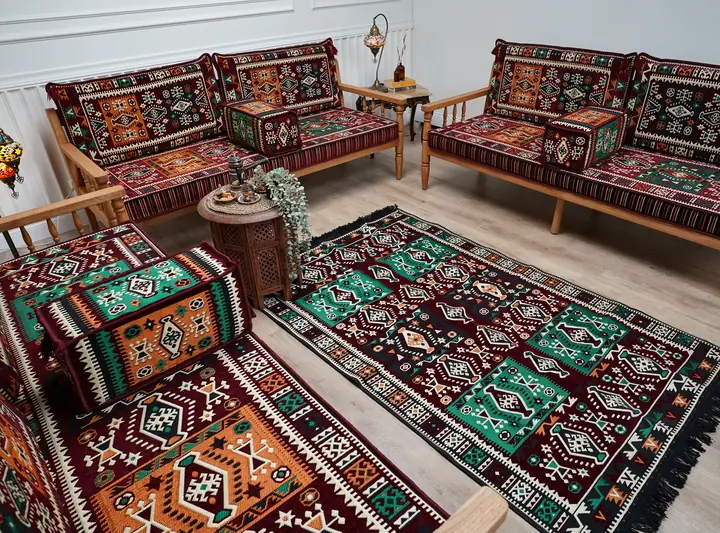
Many designs in the catalog sit between two traditions: star, royal and palace motifs known from Yemeni and Gulf majlis, and the kilim weaves and low sedir seating of Turkish homes.
The Sedir Bench line shows the meeting most clearly. A solid pine frame carries the foam seats, and the covers are a dense kilim-style weave instead of the usual upholstery fabric, so the set reads as Anatolian while the layout follows a majlis.
Plain velvet in deep or pastel shades suits rooms that want the shape of a majlis without strong pattern.
What paperwork travels with a set?
A set rarely travels as one parcel: an L-shape usually fills two or three boxes, larger layouts need more, and they do not always arrive on the same day.
Every shipment travels with a commercial invoice describing what is inside: the goods, their value and weight, and the materials they are made of. Customs in your country works from that invoice, and any duties that apply are stated in your quote.
Delivery times and costs for each country are on the delivery page.
Frequently asked questions
Is Türkiye the same country as Turkey?
Yes. Türkiye is the country's own spelling of its name and is also its official name in English, so both forms refer to the same place where every set we make is cut, sewn and finished.
Are the fabrics on your sets Turkish?
What we can state for every set is where it is made: it is cut, sewn and finished in Istanbul. A fabric name such as Turkish velvet describes the type of cloth, so ask the team about a specific fabric before you order if its origin matters to you.
Can I see my set while it is being made?
Progress photos can be shared while your set is in the workshop, from the cut foam to the sewn covers. Custom orders are photographed and filmed for your approval before they ship. We don't have a showroom; ask us for a sample box or a video call.