
Questions buyers ask
Will the upright bands sit as low on a sedir bench as on floor cushions?
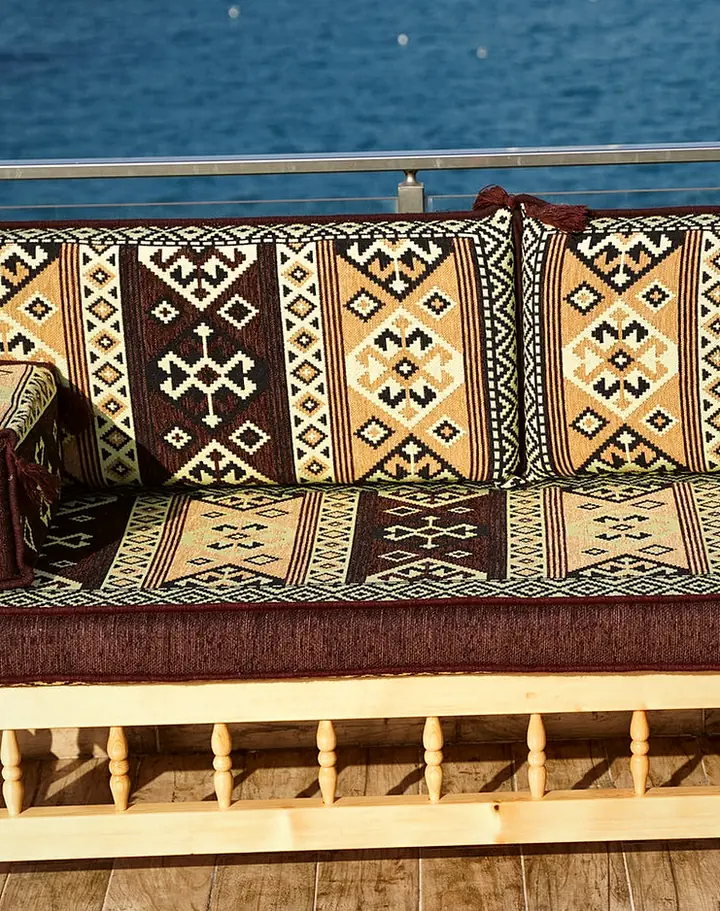
A sedir bench raises the banded fabric onto a wooden base. The standard bench measures 75 × 27.5 × 16 in (190 × 70 × 40 cm), with the seat cushion included in its approximate height. That is a different viewing level from floor cushions, so compare the vertical stripe rhythm on the bench photograph before selecting the seating form.
From the atelier
Does the wood shown beneath the banded bench belong to the covering or to the seating structure?
The exposed wood belongs to the bench structure. The Sedir Bench line uses a solid pine bench frame beneath its heavy kilim-style covering. The frame and textile are separate parts of the seat; the pattern name does not identify a wood species. This construction description applies to the bench, rather than every floor cushion carrying banded motifs.
From the atelier
Which lines hold the brown pattern together?
Broad brown fields alternate with thinner cream and camel stripes. Small angular figures appear within the lighter bands, while the larger color intervals remain visible across adjoining cushions. Follow the stripe first, then the shapes inside it: this is one way to distinguish banded layouts among the seating patterns.
On a long backrest, the upright bands break the horizontal seating line into smaller intervals. A bench puts that same rhythm above exposed wooden rails. Neither view establishes a named tribal emblem or the place where the cloth was made.
What does the word kilim contribute to this name?
Encyclopaedia Iranica describes a kelim as a flat textile whose colored wefts create the design across the warp, rather than forming a knotted pile. Its account includes banded arrangements filled with repeating geometric forms. That history explains the visual vocabulary borrowed by this upholstery name; it does not certify the current covering as a historic rug or identify its fibers.
A stripe can carry smaller figures without becoming a separate medallion field. The regular change between dark and light supplies the framework, and the angular detail supplies the closer reading. This distinction matters when a cloth is divided among separate cushion covers.
How old is the habit of arranging cloth in bands?
The British Museum records plain-weave and tapestry textile fragments from Niya dating to the third or fourth century. The record supplies an early textile example, without establishing a single birthplace or a worldwide first for every striped design. The collection name here refers to that longstanding band tradition.
The Metropolitan Museum of Art holds a much later kilim attributed to Syria, probably Aleppo, from the late nineteenth or early twentieth century. Alternating red areas and narrow multicolored stripes divide its surface. These two museum records belong to different periods and contexts; neither identifies the maker, age or origin of the present-day brown seating.
Are the little angular figures fixed symbols?
The photographs show small geometric repeats inside the bands. A visible resemblance to an arrow or a cross does not establish a ritual meaning, and the available product record does not name a particular emblem. Read them as part of the stripe pattern. A clear description can stop where the evidence stops.
How do camel and cream change the brown ground?
Brown is the photographed colorway. Camel and cream are tones within that option, rather than separate choices of the same fabric. Cream marks the narrow intervals most clearly; camel softens the contrast where those intervals meet the darker field.
I would put the brown against a quiet cream wall and let daylight fall across the backrests. Examine the cloth near a window, then move it beneath the room’s evening lamp. Ask us about fabric swatches and a foam sample before you order.
Where does a seating cover part company with a kilim rug?
The collection carries a textile-inspired design on separate seating pieces. A rug has a different job on the floor, even when both surfaces use geometric bands. The traditional floor sofa sets collection explains the seating category; this pattern story follows the visible stripes.
A photographed matching rug can help compare the scale of the repeat. It does not turn the cushion covering into a rug or prove a hand-weaving method.
Which seating surfaces carry the upright repeat?
The floor-seating arrangement uses standard long cushions measuring 75 × 27.5 in (190 × 70 cm), with 4 in (10 cm) and 8 in (20 cm) options in this product family. A coordinated ottoman measures 23.5 × 23.5 × 8 in (60 × 60 × 20 cm). These measurements describe separate pieces rather than one continuous textile or a room-sized footprint.
The bench photographs show another way to carry the same bands. Its standard 75 × 27.5 × 16 in (190 × 70 × 40 cm) measurement includes the cushion in the approximate height. The wooden structure remains visibly separate beneath the covering; the stripe pattern does not describe that structure’s finish.
Where can a dark banded field leave the room breathing?
A plain rug, a low seating line and light falling sideways across the backrests leave the smaller geometric figures legible. I would keep the neighboring curtains quieter than the stripes. Carry the window-and-lamp comparison through to the rug before deciding whether the room needs another patterned surface.
For a repeat that gathers its shapes into a broader field, compare Classic Kilim. The difference is the arrangement of the motifs, rather than a promise about either fabric’s origin.
Frequently asked questions
Does Banded Kilim describe three separately selectable colors?
Brown is the documented colorway for this pattern. Camel and cream appear within its stripes and small geometric repeats. A lighter band can look more prominent in one photograph, but that change in contrast does not establish a separate camel or cream fabric option.
Is the striped bench photograph evidence of outdoor suitability?
The bench photograph shows the layout of the covering and the exposed wooden structure. Its setting does not establish weather resistance, water repellency or suitability for permanent outdoor use. Choose the seating form from its construction information rather than the surroundings of a photograph.
Do the angular band figures identify a tribe?
The product photographs show repeated angular shapes within the pale bands. The source record does not connect them to a specific tribe or give them a confirmed symbolic meaning. Banded Kilim names the visible arrangement, so an origin or emblem should not be inferred from the shape alone.