
Questions buyers ask
Are the green checked backrests sewn onto the plain green seat as one patterned section?
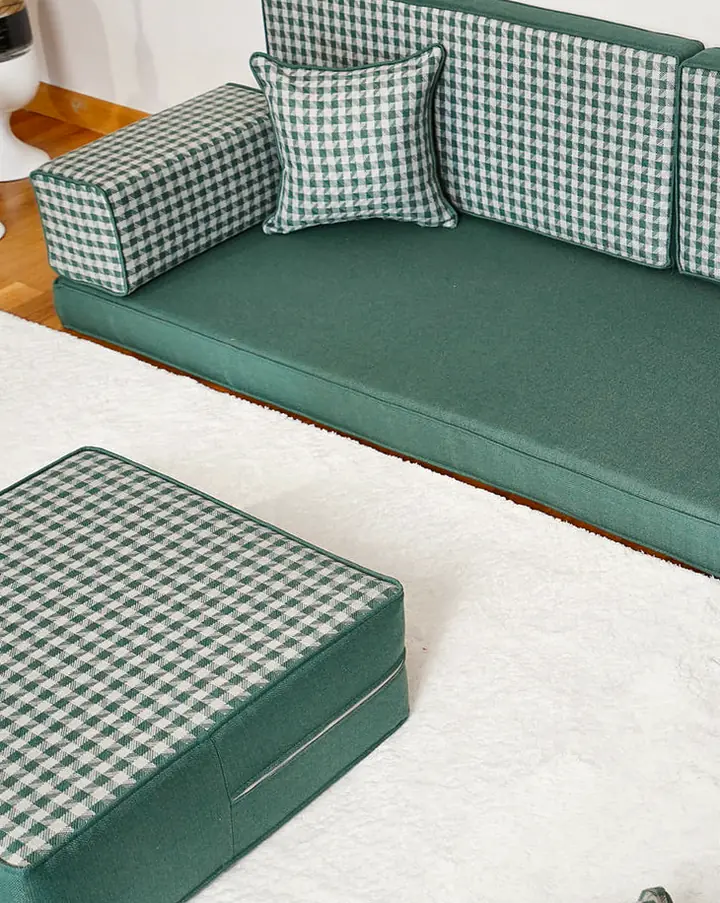
The checked backrests are separate pieces, rather than a continuation sewn onto the seat. In the green photograph, their outlined edges mark the individual cushions above the plain seat. Read the checked faces as separate accents when comparing them with the blue and terracotta versions.
From the atelier
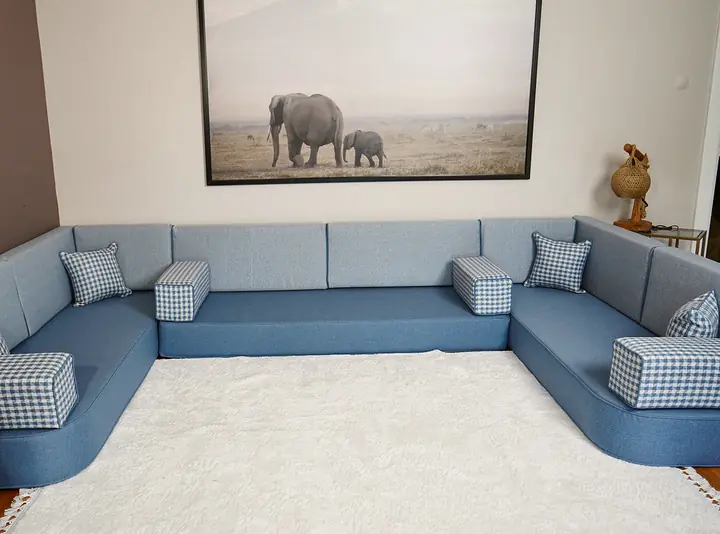
Could the blue ottoman's checked face repeat in a fabric detail elsewhere in the room?
Matching upholstery fabric can also be ordered by the meter. Use the blue ottoman photograph to identify the small check, and ask us about the corresponding fabric. That request distinguishes the checked cloth from the blue seat material; it does not establish a new colorway.
From the atelier
Where does the small check appear on this seating?
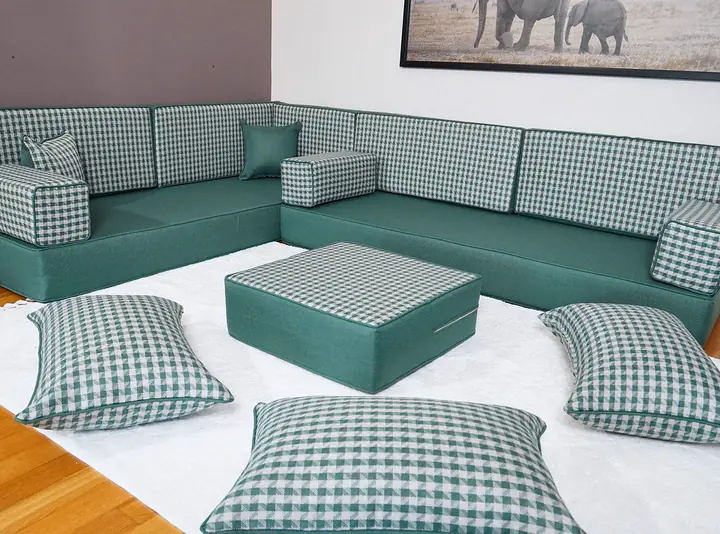
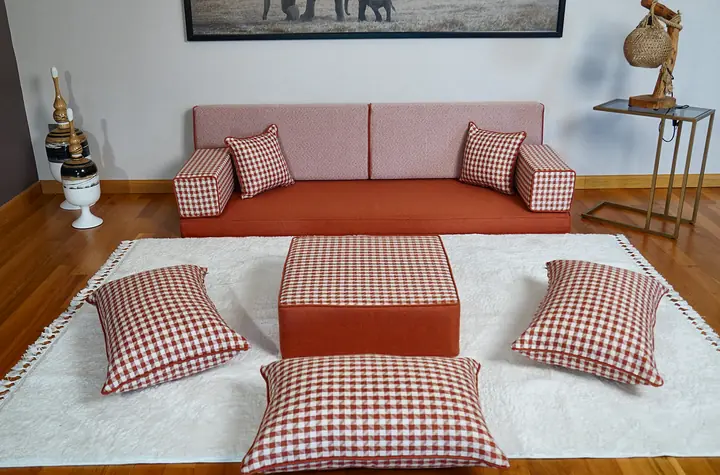
The small check appears chiefly on the bolsters, loose pillows and square ottoman tops, while larger seat areas carry a single color. In our pattern index, Gingham stands out through that contrast between tiny repeated squares and broad cushion faces. The green set also places checks across the long backrests. Blue and terracotta keep those backs in companion shades.
Look closely at a checked armrest: colored lines cross white lines, producing darker squares where they overlap. The eye follows both directions equally. I would let those little squares be the room’s smallest repeat, with larger blocks of color on the rug and curtains.
How did a name for stripes become attached to these squares?
According to Oxford University Press’s dictionary, the early seventeenth-century English name passed through Dutch gingang from Malay genggang, originally describing stripes. Its present-day definition identifies white and colored squares. The older word and the familiar check therefore describe different stages in the name’s use, rather than proving a particular origin for the photographed upholstery.
Merriam-Webster records an English use in 1615 and describes gingham as a plain-weave clothing fabric, usually made with yarn-dyed cotton. That dictionary definition explains the textile term. It cannot establish the fibers or manufacturing technique of a sofa cover that shares its appearance. Here the check is a visible design; the photographed cloth’s weave or print method remains to be confirmed.
Does the check carry a fixed symbolic message?
The check is used here as a repeated geometric decoration, without a claimed protective or ceremonial meaning. Its design is easy to follow because the same small squares return across each accessory. A patterned pillow beside a plain one shows the difference immediately. The Malay word history explains the name, while the catalogue photographs explain where the repeat sits on this seating. Neither identifies these covers as a historical textile or a piece made by a particular weaving community.
What changes when the check moves from blue to green or terracotta?
| Colorway | Ground | Motifs | Borders |
|---|---|---|---|
| Blue | Blue seat and lighter blue backrests | Blue-and-white checks on bolsters, pillows and ottoman top | Blue edging on checked pieces |
| Green | Muted green seat | Green-and-white checks across backs, bolsters, pillows and ottoman top | Green edging around checked faces |
| Terracotta Orange | Terracotta seat and pale coral backrests | Rust-red-and-white checks on bolsters, pillows and ottoman top | Terracotta edging around checked faces |
Green brings the most checked area to the wall because the backrests join the smaller accessories. Blue leaves the back line lighter, with a deeper seat below it. Terracotta sets the rust-colored checks against coral backs. I would compare green beside an existing striped curtain first: both repeats will be visible from across the room, rather than only at the ottoman.
Ask us about fabric swatches and a foam sample before you order. Set the relevant cloth beside your wall or curtain in daylight, then compare it in the room’s evening light. Keep the companion seat shade and the checked accent beside each other during both comparisons.
How does a checked accent differ from the linen-look seat fabric?
The checked accent names the repeat, while linen floor sofa describes the seating collection and its fabric appearance. These are different choices: a buyer can like the small squares without needing the material story of every linen-look fabric. Fiber percentages are not established here.
The seat module measures 75 × 27.5 in (190 × 70 cm), with 4 in (10 cm) and 8 in (20 cm) options in the Gingham collection. Long backrests in a corner arrangement use 37.5 × 16 × 4 in (95 × 40 × 10 cm), with a 23.5 × 16 × 4 in (60 × 40 × 10 cm) short backrest at the turn. These dimensions describe the pieces carrying the pattern, rather than the size of an individual printed or woven square.
Which seating arrangements show the check differently?
Single-wall and L-shaped arrangements are photographed in blue, green and terracotta; the U-shaped catalogue views show blue and green. A single run makes the checked armrests frame one plain seat, while the corner layouts distribute the smaller accessories around a larger open center. The bolsters measure 19.5 × 8 × 8 in (50 × 20 × 20 cm), and the square foam ottoman measures 23.5 × 23.5 × 8 in (60 × 60 × 20 cm). Its checked top makes the repeat visible horizontally, alongside the upright faces on the bolsters.
The gallery demonstrates those differences without turning the seating into an all-over checked surface. Compare the actual checked pieces in each arrangement, especially the green backs, rather than assuming every layout places the accent cloth in the same locations.
What could sit beside the check without repeating it?
A plain rug gives the small squares a larger uninterrupted area beside them. I would pair the blue seat with an off-white rug and a lamp that lights the wall behind the backs, keeping the checked pillows in the foreground. Use one checked accessory as the starting point, then consider the larger room colors around it.
For a change from straight crossing lines to curved ornamental figures, compare the Ciragan pattern. The contrast concerns motif shape; each fabric still needs its own color comparison in the intended room.
Frequently asked questions
Why are the green backrests checked when the blue ones are not?
The photographed green arrangement uses the small check across the backrest faces as well as on the bolsters and loose accessories. Blue keeps the backrests in a lighter companion shade. This is a visible difference between catalogue versions, rather than a promise that any placement can be changed.
Does the word gingham prove these covers are woven cotton?
The dictionaries describe a historical fabric term, while this page identifies a visible check on sofa upholstery. The catalogue name does not establish the cover’s fiber proportions or whether its checks are woven or printed. Confirm those specifications for the particular cloth before choosing it.
Is terracotta pictured as a U-shaped set as well?
The supplied Gingham catalogue shows terracotta on single-wall and L-shaped arrangements. The U-shaped views available here are blue and green. The gallery therefore demonstrates terracotta through the photographed layouts and makes no claim about a terracotta U-shaped version.