
Questions buyers ask
Does a Kırşehir corner require the same number of wooden benches as a three-sided arrangement?
Wooden bench sets can use one, two or three benches, so a corner and a three-sided arrangement need not share the same configuration. The blue cushions carry the pattern above a separate wooden structure. Compare the chosen bench arrangement with the low floor version before identifying which construction the photograph represents.
From the atelier
Is a full Kırşehir floor U counted in the same way as the wooden bench arrangement?
The usual full Kırşehir U-shaped floor set has 19 pieces, including the seating and its loose accessories. Wooden benches belong to a separate construction and should not be counted as that floor package. The photographed blue arrangement helps identify the pattern; confirm the selected package, especially its rug provision, before comparing totals.
From the atelier
How can the stepped figure be recognized without its place name?
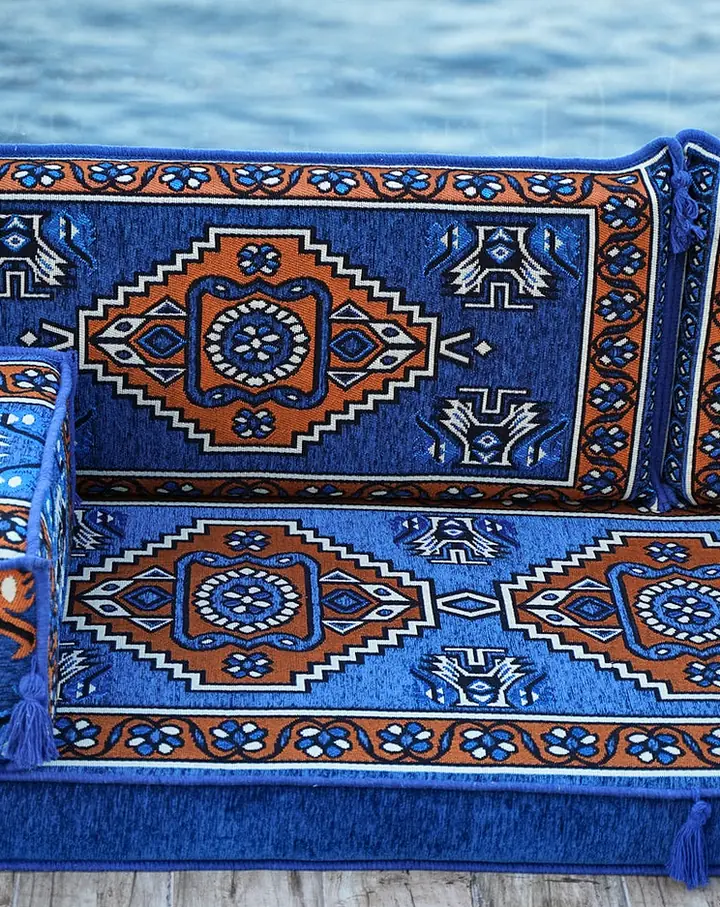
Orange figures with cream stepped edges stand out against the blue backrests, while smaller diamonds and hooked forms fill the surrounding ground. A circular floral center sits inside each larger outline. In the majlis pattern index, Kırşehir is distinguished by this broad blue field and the warm ornament above it. The seat faces repeat the larger figures horizontally, while the armrests introduce a different arrangement of the smaller geometry.
Which historical rug tradition does the Kırşehir name recall?
Kırşehir names a central Anatolian rug tradition, with prayer rugs documented in museum collections. Arış’s study of the Ankara Ethnography Museum collection describes single-niche, double-niche and niche-free compositions. Among the arched examples, stepped contours rise toward the top of the field. Carnations, lamps and small geometric fillers also occur in the collection. These observations concern historical rugs, rather than the construction or fiber content of the blue seating covers.
The Metropolitan Museum of Art describes a late sixteenth-century Ottoman prayer rug whose central arch and small format suggest its use for prayer. That object provides a wider Ottoman comparison for an arch-shaped composition. It is not identified here as a Kırşehir rug, or as the source of this particular cushion design.
Does the cushion reproduce a prayer niche or its symbolism?
The cushion shows enclosed stepped medallions, without a prayer niche. The historical name supplies a reference for angular contours, while the blue ground and orange figures form a seating design in their own right. Arış’s account shows that the historical collection contains different compositions; it does not establish a sacred meaning for the figures on this upholstery.
Where does the pattern become quieter across a complete seat?
The side band is plain blue, so the strongest ornament stays on the upper seat and backrest faces. From a doorway, the blue field links the individual pieces before the small fillers become legible. At closer range, cream edges outline the warm central figures. The contrast is between patterned faces and simpler sides, rather than between two separate regional designs.
What do the blue ground and orange borders contribute to the room?
| Colorway | Ground | Motifs | Borders |
|---|---|---|---|
| Blue / Royal Blue | Strong blue cushion faces with plain blue sides | Orange stepped figures, cream outlines and small dark details | Orange bands with pale floral details |
The photographed palette combines a cool broad field with warm figures and bright cream edges. Those edges remain visible when a whole bench is seen from across the room. I would put the blue seat beside a pale gray wall before adding another orange furnishing; the existing motif already supplies a strong warm accent.
Ask us about fabric swatches and a foam sample before you order. Check the blue ground beside the wall in daylight, then under the lamp normally used for the seating. Compare a plain area and a patterned area together, because a small orange detail alone will not show how much blue the room receives.
How does the same blue design differ between floor cushions and a sedir?
The floor arrangement sits on cushions, while wooden bench Arabic majlis describes the raised seating category shown by the sedir photographs. The stepped ornament belongs to the cover; the visible rails and legs belong to the wooden construction. Similar colors do not make those two structures interchangeable.
A wooden bench measures approximately 75 × 27.5 × 16 in (190 × 70 × 40 cm) with its seat cushion included. The approximate 16 in (40 cm) height is an overall reference, not a frame height to which another cushion is added. A standard floor-seat footprint is 75 × 27.5 in (190 × 70 cm). Long backrests have the usual size 37.5 × 16 × 4 in (95 × 40 × 10 cm); confirm the chosen arrangement instead of inferring a specification from the size of a medallion.
Which Kırşehir seating can carry these figures along a wall?
The floor catalogue includes a single-wall arrangement, a corner and a U, while the bench photographs show a separate sedir construction. Orange figures repeat across the back cushions in each view, with plain blue along the seat sides. Select the intended construction before comparing the amount of patterned surface.
An individual seat is at most 75 in (190 cm) long. A longer wall run is divided into equal pieces, each within that limit. These are the seating rules behind the design, rather than a promise that a large figure continues unbroken across every join. Ask us whether a matching rug is included with your set.
What can accompany the blue figures without adding another busy repeat?
A plain pale rug and an uncomplicated wall leave the orange contours easy to distinguish. I would pair the blue seating with a cream rug and a lamp aimed toward the cushion faces. Keep any smaller accessory near the seat in one quiet color, allowing the existing flower-like borders to supply the detail.
For a different scale of geometry, the Gingham pattern places small crossing squares beside larger plain areas. Compare the size and placement of the repeats before comparing the color names. A matching shade alone does not make two patterns read in the same way.
Frequently asked questions
Does Kırşehir seating contain a prayer niche?
The photographed cushion faces use enclosed stepped figures rather than a prayer niche. The historical rug name describes a design reference, without identifying these seating covers as prayer rugs.
Are Blue and Royal Blue two guaranteed different fabrics?
The catalogue uses both color labels, while the photographs show a strong blue ground with orange and cream details. Confirm the current cloth instead of assuming two distinct shades.
Does the regional name establish how the cover was woven?
The name connects the design with a rug tradition. It does not establish the upholstery’s fiber composition, weaving method, dye process or manufacture in Kırşehir. Confirm the particular cloth separately.