
Questions buyers ask
Does the raised Lale photograph tell me whether the foam is one block or stacked layers?
Confirm the build beneath the floral cover. Full foam can use two 8 in (20 cm) layers for 16 in (40 cm), or 8 in (20 cm) plus 4 in (10 cm) for 12 in (30 cm). These combinations describe foam cushions, and establish neither the wooden base nor the photographed seat’s height.
From the atelier
When comparing Lale with wooden bench seating, should I add a cushion on top of the stated bench height?
The standard wooden bench reference is 75 × 27.5 × 16 in (190 × 70 × 40 cm), with its approximate height already including the cushion. Adding another cushion height would count it twice. This reference helps compare seating forms; it does not establish a currently orderable Lale bench or the height of the photographed diwan.
From the atelier
What identifies the tulip in the Lale pattern?
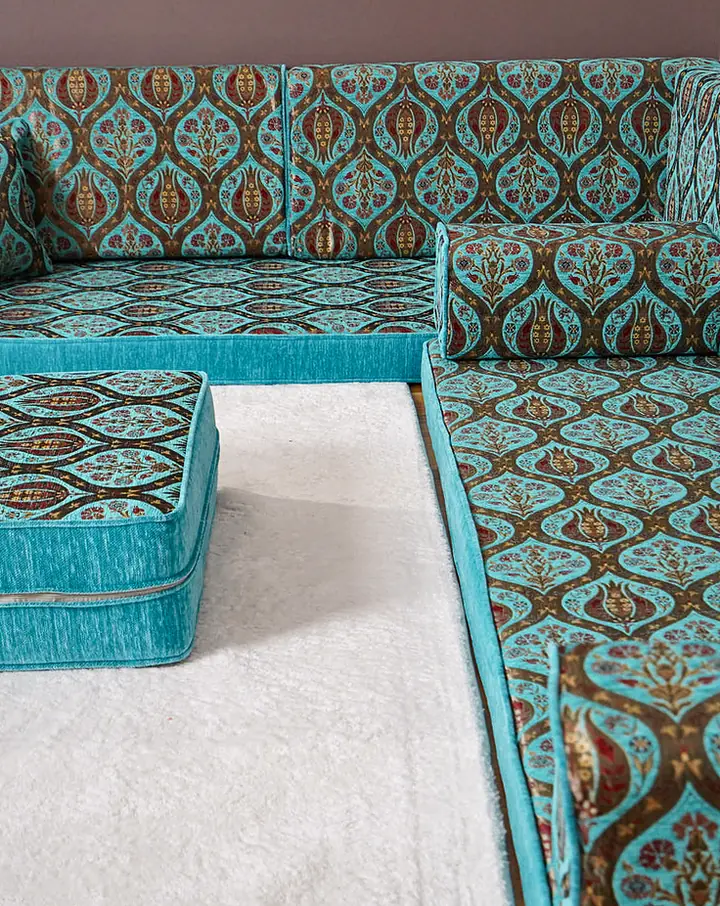
A pointed flower enclosed by a curving ogee frame is the main unit of the Lale pattern, repeated across the upholstered surfaces. Smaller leaves and floral details fill the spaces within those frames, so the design remains busy even when seen close to a cushion edge. Among the upholstery patterns, Lale uses a recognizable flower as its starting point rather than an abstract geometric figure.
The flower’s pointed outline is easier to isolate in the red and gold close-up than in a distant photograph of the whole sofa. I would follow one framed stem, then examine the curve around it.
Where does Lale fit in Ottoman textile history?
Lale is the Turkish word for tulip, a flower that became part of the Ottoman decorative vocabulary. Carnations and other garden flowers appear alongside it. The Metropolitan Museum traces a classical floral style through sixteenth-century Ottoman textiles, with forms shared across different decorative media. Its account also discusses furnishing fabrics and cushion covers, making textiles a useful comparison for this modern upholstery motif without identifying it as a copy.
The museum also follows floral textiles into the early eighteenth century. That longer span matters: a tulip motif does not belong to one brief fashion period, nor does its presence date a modern fabric.
What does the Iznik tile comparison show?
The Iznik comparison shows a related floral vocabulary in ceramic decoration, rather than proving a direct design source for this upholstered Lale collection. Fitzwilliam Museum dates its featured Iznik tile to 1575–1600. It identifies a blue tulip beside red carnations and a jagged saz leaf. Those different flowers share the decorated surface, offering a concrete museum example of how a tulip could sit within a larger Ottoman floral composition.
A glazed tile and a sewn cushion also handle their frames differently, even when both make space for a pointed flower and curling leaves. Ceramic decoration covers a hard surface; this upholstery repeat continues across soft pieces and meets seams, piping and the edges of removable cushions.
Does a tulip motif carry one fixed meaning?
A tulip can suggest an Ottoman garden tradition without assigning the same meaning to every modern floral fabric. The museum sources document decorative forms and historical objects, not a universal symbolic reading for these cushions. Keep a possible association separate from what the furniture represents.
How do the three Lale colorways change the floral contrast?
The three catalog colorways keep the framed floral repeat while changing the balance between the ground, outlines and smaller flower details around it. I would set the close-up beside a plain curtain sample, so the flower remains easy to recognize without another floral print competing for attention.
| Catalog colorway | Visible palette | A pairing to compare |
|---|---|---|
| Red | Red ground with gold-toned tulips and ogee outlines | Plain cream or muted tan |
| Turquoise | Turquoise ground with brown and warm metallic-toned details | Quiet cream upholstery |
| Stone Gray | Cream base, charcoal-brown outlines and red flower accents | Plain gray or warm off-white |
The Stone Gray name identifies a catalog colorway; it does not mean that every part of the upholstery is gray in the photograph. Ask us about fabric swatches and a foam sample before you order.
Is Lale a pattern name or a different kind of diwan?
Lale names the floral covering, while diwan seating describes the furniture form that carries it in this catalog collection. A photograph of the tulip repeat cannot establish the cushion’s internal layers, back support or finished sitting height by itself. The separate seating specification answers those construction questions, keeping the patterned cover distinct from the build beneath it when different forms are compared.
Which current Lale seating can be compared in the catalog?
The Lale Tulip Diwan Floor Sofa is the current product reference, with configuration details and pictures of its framed flowers. Standard floor seats use 75 × 27.5 in (190 × 70 cm); ready floor cushion options are 4 in (10 cm) or 8 in (20 cm) thick. These references do not verify a photographed raised base’s height, and a bench measurement already includes its cushion.
Use an isolated fabric detail to judge the flower, then return to a wider photograph to see how often the frame repeats. Keep the furniture specification beside that visual comparison. A pattern gallery shows the covering on several surfaces, while the product description identifies the selected configuration and its included parts.
Which floral neighbor should you look at before choosing Lale?
The Ciragan pattern offers another Ottoman-oriented floral comparison, with a different arrangement and a quieter green-centered catalog palette beside Lale’s framed tulips. I would compare the outlines before the color names. Return to the close-up to judge whether the pointed flower or its curved frame is the feature you want to emphasize.
Frequently asked questions
Is Lale the Turkish name for the tulip?
Yes, lale means tulip in Turkish. Here it is the collection name for a modern upholstery pattern with stylized tulips inside repeated ogee frames. The name gives the design a clear floral reference; it does not date the fabric or identify its manufacturing origin.
Are the Lale cushions copies of the Fitzwilliam Iznik tile?
The tile is a historical comparison, not an identified source drawing for this furniture. Its blue tulip appears with carnations and a saz leaf on ceramic. Lale’s modern upholstered repeat places stylized flowers within ogee frames and carries them across cushions, armrests and an ottoman.
Why does the Stone Gray photograph include cream and red?
Stone Gray is the catalog colorway name for a multi-colored design. The photograph shows cream areas, dark gray-brown frames and smaller red floral accents. Judge those different areas together through the close-up and a sample comparison, rather than expecting a uniform gray upholstery surface.