
Questions buyers ask
How many long red pattern fields does an L or U layout place along the walls?
A standard L layout places two long seat cushions along the walls, while a U places three. Each standard cushion measures 75 × 27.5 in (190 × 70 cm). Those counts describe the main seating fields, where the red ground and key borders repeat; they are not the total accessory count and do not describe doubled cushion layers.
From the atelier
What happens between choosing the key-bordered cloth and receiving shaped cushion covers?
After the fabric reaches the atelier, the cloth and foam are cut and the covers are sewn around the selected seating pieces. Progress photographs come before packing. This sequence describes present-day cushion production; the historical key motif does not imply imported antique textiles or an ancient method of making the covers.
From the atelier
Where does the key turn on a red cushion?
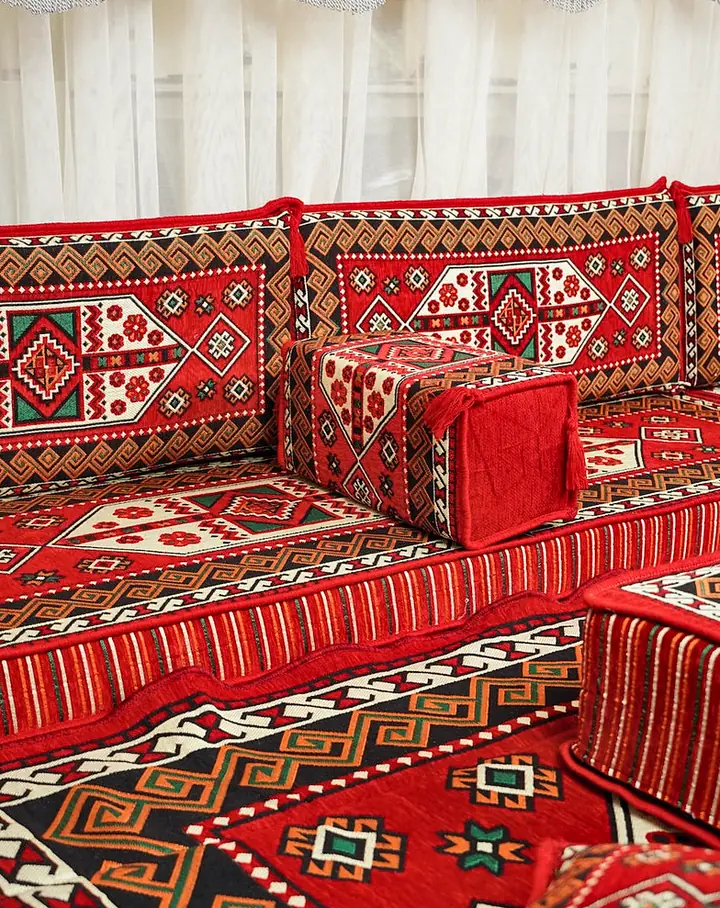
Trace the pale edging around a backrest: the line advances, turns and returns before repeating. Larger geometric figures occupy the middle, and narrow stripes distinguish the sides of the seating. The border and the center have separate jobs. This edge-led composition belongs among the pattern families whose repeats remain readable across individual covers.
Looking closely at one corner makes the construction of the ornament easier to see than surveying the whole room. The key supplies direction; the red ground supplies the space around it.
Why does a straight-edged ornament carry a river’s name?
The Metropolitan Museum of Art’s Greek art guide links the name meander to the winding Maiandros River in Asia Minor. The river reached the Aegean, while the decorative line translated turns into a repeated geometric course. The resemblance is an association behind the name, rather than a map of one particular bend.
A river curves continuously; a key border makes corners. Keeping that difference in view avoids treating every angular turn as an exact drawing of a landscape. The current red cushion design borrows the border’s recognizable rhythm without claiming an ancient place of manufacture.
How did the key become part of a wider decorative language?
The Museum of Cycladic Art describes the Early Geometric period, from 900 to 850 BCE, as a move toward straight-line decoration, including meanders arranged in narrow bands. Its account of the following period describes broader, framed meanders. These examples concern ancient Greek pottery and changing ornament, rather than modern upholstery.
The Metropolitan Museum of Art also describes the Greek key as a recognizable element used in later classical references in dress. A motif can move between media while retaining its turning line. That later history helps explain recognition today, but it supplies no evidence that the current cloth was woven with an ancient technique.
Does a continuous border promise a symbolic meaning?
Continuity is visible in the way the line repeats, but a promise of eternity, protection or good fortune is not established by the product record. It is enough to describe the connected turns and the contrast with the central figures. The name explains an association; it does not assign a belief to everyone who uses the ornament.
What makes the pale border stand apart from red?
The photographs document red cushions with lighter geometric details and narrow contrasting stripes on their sides. Pale edging gives the eye a route around the stronger field. Red is one colorway here; changing daylight and lamplight can change its apparent depth without creating additional color options.
I would keep the adjoining wall calm enough for the key to remain visible. Inspect the cloth first near daylight and then under the lamp that lights the seating. Ask us about fabric swatches and a foam sample before you order.
Which part belongs to the pattern, and which to the seating?
The key describes an arrangement of lines on the cloth. Separate seats, backrests and armrests describe how the upholstered pieces meet along the walls. The floor sofas collection follows that seating form, while Meander follows the border and the red geometric field.
A photographed rug repeats some of the visual language at floor level. It remains a separate surface, and its presence does not prove that a cushion cover is a rug, an antique textile or a hand-woven object.
How does the repeat cross a modular arrangement?
The standard long seat cushion measures 75 × 27.5 in (190 × 70 cm), and this product family offers 4 in (10 cm) and 8 in (20 cm) seating options. A matching ottoman measures 23.5 × 23.5 × 8 in (60 × 60 × 20 cm). Compare the close photograph with the full arrangement to see where the key remains on the backrests and where a different stripe runs along the sides.
An L arrangement places two main long seat fields against the walls; a U places three. That difference changes how often the border returns at a corner. It does not describe the complete accessory count or imply that every visible item belongs to every package.
Which neighboring surfaces let the border keep its course?
A quieter rug, the red seat and light grazing the pale edging let the line remain distinct at room scale. I would repeat one pale tone in the curtains and leave the wall without another strong geometric repeat. Revisit the window-and-lamp comparison before combining the red with a large existing rug.
The Hooked Medallion pattern gives a useful comparison: its hooked forms organize the field, while Meander’s most recognizable line follows the edge. This is a difference in visible layout, rather than an origin claim.
Frequently asked questions
Does Meander require a perfectly square path around every cushion?
The key is a repeating angular border, but individual cushion edges, seams and photographed angles can interrupt how much of that border is visible. The design is identified by its returning line. A product photograph does not guarantee that every finished seam will fall at the same point in the repeat.
Is the red fabric an ancient Greek textile?
No ancient textile origin is claimed for this covering. The Museum of Cycladic Art documents meanders in ancient decoration, and The Metropolitan Museum of Art connects the motif’s name with the Maiandros River. Those historical references explain the ornament, rather than the age or manufacture of these cushion covers.
Does Kızıl Kilim mean there is another Meander product family?
Kızıl Kilim is a registered alternate name for Meander in the collection. It does not create an additional product family or a second set of colorways. The photographed modular seating is the same red design, with the pale key border identifying the pattern around its backrests.