
Questions buyers ask
Does the gray floor seat have the same wooden structure as the open-railed bench?
The floor seat is all foam, with no internal wood or metal frame and no springs. Its foam gives it shape. The open rails and base visible under the bench belong to a different construction, even though both photographs show closely related hooked geometric motifs.
From the atelier
Would an extra layer under the gray seat automatically line up its hooks with the existing cover?
Adding 4 in (10 cm) beneath a 8 in (20 cm) seat raises it to 12 in (30 cm); adding 8 in (20 cm) raises it to 16 in (40 cm). Those figures describe height. They do not establish where a new cover’s motifs would meet the old ones. Share the seat photograph so that alignment can be considered separately.
From the atelier
What makes the medallion look hooked rather than smoothly curved?
Each large lozenge has an angular outline, with short projections turning back toward its edges. Smaller diamonds repeat between the larger figures, while the seat panels introduce broad rectangles. Among the designs in the pattern collection, Hooked Medallion is easy to recognize through these interrupted outlines and the dark ground around them.
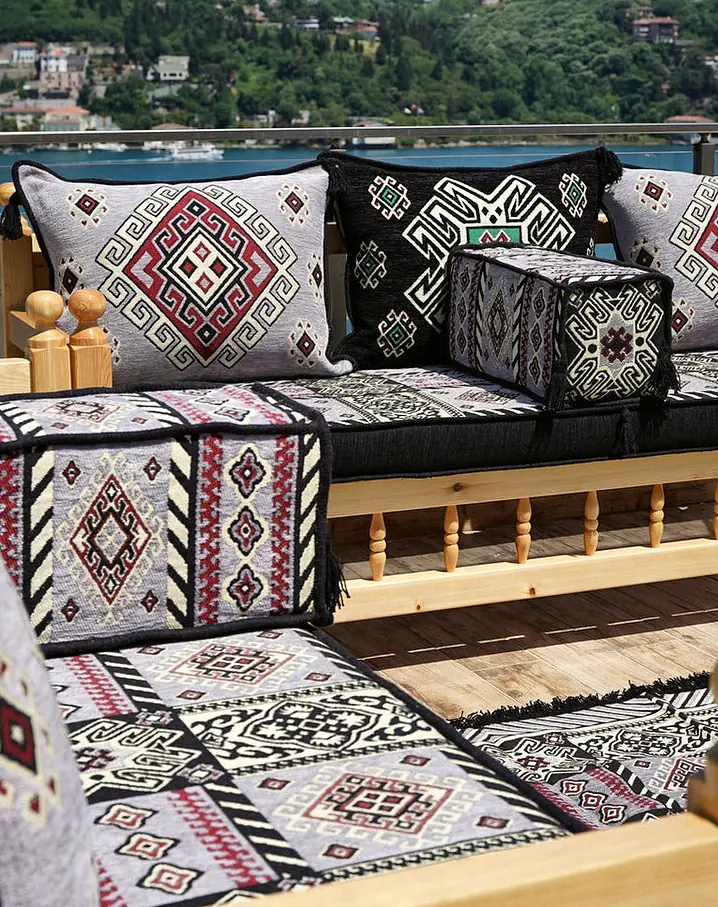
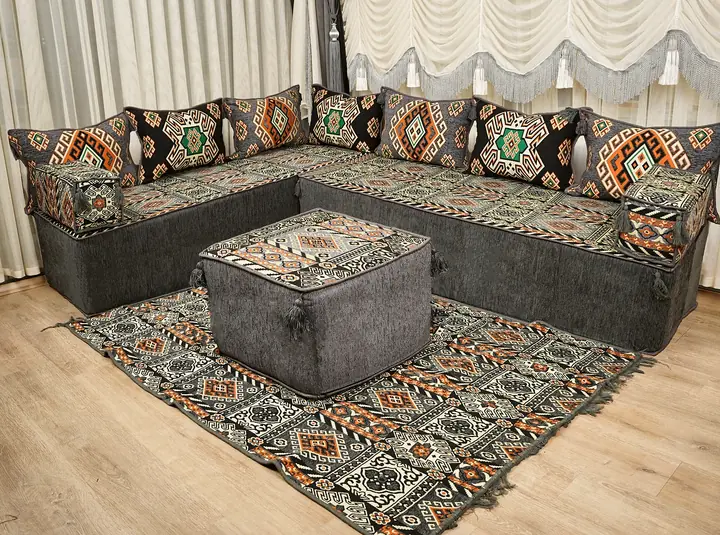
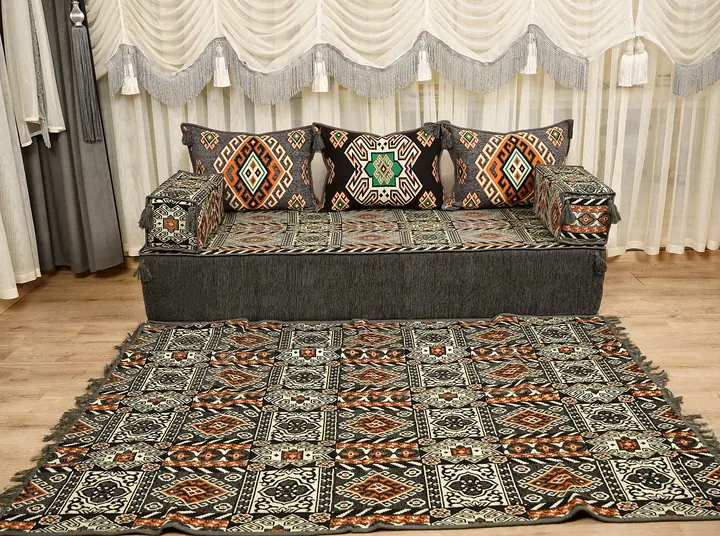
The gray floor cushions place orange and cream figures against charcoal, with small green centers. On the gray wooden bench, pale geometric bands stretch along black seat panels.
Where do hooks and stepped outlines fit within the kilim tradition?
Samsun’s Provincial Directorate of Culture and Tourism records hook motifs among the designs used in Vezirköprü kilims. Its account describes them alongside other angular ornaments arranged in bands. That regional example places hooks within an Anatolian weaving vocabulary; it does not identify these modern upholstery covers as textiles from that district.
Encyclopaedia Iranica explains that a tapestry-woven kilim uses colored wefts within their own design areas. Where neighboring colors turn back separately, a slit can form. Long vertical slits weaken the fabric, so stepped or interrupted boundaries offer a practical way to avoid them. This helps explain the angular drawing found in historical kilims. It concerns the weaving tradition, rather than establishing how a photographed sofa cover was made.
Does this medallion have one documented symbolic meaning?
Here the name identifies a visible shape: a central lozenge edged with returning hooks. The cultural sources explain weaving and record a regional motif vocabulary, but do not assign a single meaning to this particular upholstery design. A green center within an orange lozenge can therefore be described as a color placement without treating it as a protective sign.
Four outer corners define the large figure, with smaller hooked details interrupting its border. I would follow that outline first, then look for the little diamonds between neighboring medallions.
How do gray and mustard change the contrast between the figures?
| Colorway | Ground | Motifs | Borders |
|---|---|---|---|
| Gray | Charcoal floor cushions or black bench seat panels | Gray, cream and orange or brick-red figures with small green details | Dark outlines and contrasting geometric bands |
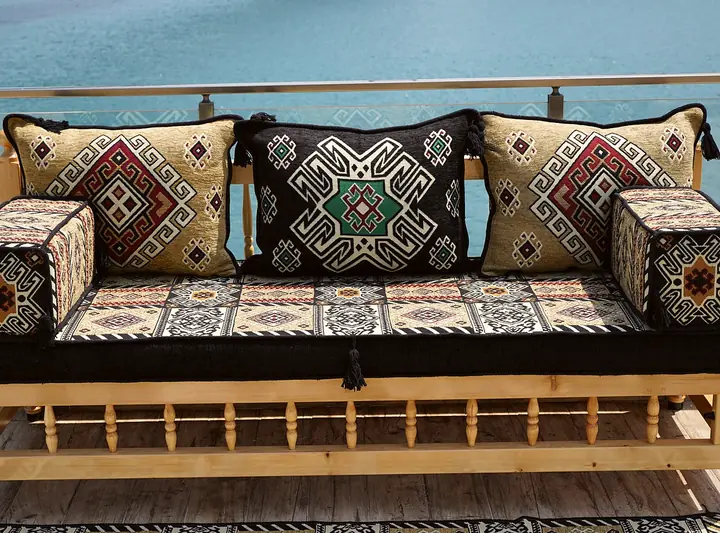
| Mustard Yellow | Gold-yellow cushion faces beside dark seat panels | Cream and brick-red angular figures with green centers | Black edging and dark geometric bands |
Mustard puts a broad gold area behind the upright figures, whereas charcoal lets orange and cream do most of the work. The bench photographs also show how a black seat can hold a long pale band beneath patterned backrests. I would compare mustard beside an existing dark bookcase first; the shelf and the cushion ground will occupy large areas in the same view.
Ask us about fabric swatches and a foam sample before you order. Place the relevant sample beside that bookcase, a rug edge or the room’s wall finish in daylight. Compare it again under the light you normally use for the seating, keeping both the dark ground and a colored motif visible.
How does this upholstery relate to a kilim rug?
The hooked figures borrow a recognizable geometric vocabulary. Kilim rugs concern a separate furnishing category: the textile lies beneath the seating rather than covering a cushion. The visible resemblance does not establish that a sofa cover was handwoven, or that it shares a rug’s fibers and manufacture.
For the floor seating, the standard seat surface measures 75 × 27.5 in (190 × 70 cm). The bolster measures 19.5 × 8 × 8 in (50 × 20 × 20 cm), while the foam ottoman measures 23.5 × 23.5 × 8 in (60 × 60 × 20 cm). A large medallion appears differently on each face: upright on a backrest, along a boxed armrest and horizontally across a seat. These piece dimensions describe the upholstery surfaces, rather than the spacing between individual hooks.
Which arrangements carry this geometric design?
The catalogue includes single-wall, L-shaped and U-shaped floor arrangements, alongside the open-railed wooden bench. The gallery pairs a charcoal U-shaped floor view with gray and gold bench views, then brings the mustard floor cushions closer. This shows how the same broad vocabulary spreads along a wall or continues around a corner.
A wooden rail changes the lower edge of the composition: the patterned seat rests above an exposed base. Floor cushions bring their panels down close to the rug. The close view distinguishes a backrest medallion from the longer bands across the seat.
What could accompany the medallions without adding another large ornament?
A plain fabric panel or a rug with a quiet border leaves room for the larger hooked figures. I would put a small round side table beside the gray bench, so its circular top interrupts the repeated angular lines. The table can hold a reading light without introducing another broad motif across the seating wall.
For a finer repeat, compare the Gingham pattern. Its crossing lines create small squares, while these cushions organize larger lozenges around colored centers. That difference gives a useful starting point when deciding how much pattern should be visible from the doorway.
Frequently asked questions
Are the pale bands on the bench seats the same shape as the backrest medallions?
The bench seat panels show elongated geometric bands, while the backrests give more space to lozenge-shaped figures. Related colors and angular details connect them visually. The photographs therefore show different placements of the motif vocabulary, rather than an identical repeat covering every cushion face.
Does the kilim name mean the sofa covers are handwoven?
The name describes the geometric appearance of the photographed upholstery. Encyclopaedia Iranica explains historical kilim weaving, but that account cannot establish the manufacturing method or fiber composition of these covers. Confirm the particular cloth’s specifications when those details matter to your choice.
Is the mustard version only shown on a wooden bench?
Mustard appears on both floor seating and an open-railed wooden bench in the catalogue photographs. Gold-yellow cushion faces carry cream, red and green details above darker panels. The gallery includes a floor arrangement and a separate bench view so that their constructions can be compared directly.