
Questions buyers ask
Do you have rugs big enough to cover the whole floor inside the seating area?
Larger rugs are available beyond the matching rug in a full set. Turkish rugs of about 79 × 118 in (200 × 300 cm) are offered, and smaller extra rugs can be combined to cover more floor. Send the floor area inside your seating, from the front edge of one seat to the opposite one, and the team can suggest a combination.
From the atelier
Can I choose my own fabric color if I don't like any of the colors shown on the website?
Many models can be made in a fabric and color you pick from our numbered fabric catalog, which covers more shades than the website shows. Patterns such as Afghan Gul come only in their listed colorways, so a plain fabric is often the answer when you want a different color. Send a photo of the shade you have in mind and the designer suggests the closest matches.
From the atelier
Where does the word gul come from, and what does a gul look like?
Gul is the Persian word for flower. In rug weaving it names the repeating medallion that stamps a carpet's field, most often an eight-sided shape split into four colored quarters or a ring of petals. Ersari, Salor, Tekke and Yomut weavers each kept a gul of their own, so each outline is a clue to which group wove the rug. Octagons are one repeat structure among our majlis patterns, alongside lattices, kilim stripes and damask.
I like to think of a gul as a stamp pressed again and again into a field of color, read from a few steps away on a floor seat instead of from above.
Why do Afghan rugs carry Turkmen designs?
Many of the Afghan rugs sold today follow a Turkmen layout, because Turkmen communities weave in northern Afghanistan too. Picture an octagon on a deep red ground and most buyers will call it Afghan.
UNESCO inscribed Turkmenistan's carpet tradition on its intangible heritage list in 2019, and the file describes designs tied to one of five main Turkmen tribes.
Is Bukhara a place, a rug or a look?
In the rug trade a Bukhara is a look: octagon after octagon on a deep red ground. The name belongs to the Uzbek city on the old Silk Road whose markets handled such rugs, not to a loom there, because Turkmen groups wove them out on the surrounding steppes. UNESCO has listed the city's historic center as a heritage site since 1993.
The look descends from the Tekke main carpet, which the Metropolitan Museum of Art describes as the primary floor covering of a Turkmen tent, and its quartered gul traveled to many weaving regions. Nothing we sell is a Bukhara, and our covers are fabric, not rugs, which is why the story sits on this page and not on one of its own.
Is a gul a symbol or a signature?
I would call a gul a signature before a symbol. Each Turkmen group drew its own forms, which makes a gul closer to a family crest woven into wool than to a picture of anything. The old Western guess that it depicts a tent or a totem finds no backing among weavers, so it stays out of this page.
From these rugs the pattern keeps a skeleton: one large gul repeated down the field, small fillers in the gaps and a border to close the frame. A border is where a pattern tells you how it wants to be placed.
Which ground fits your light: maroon, navy or gold?
| Colorway | Ground | Gul colors | Small motifs |
|---|---|---|---|
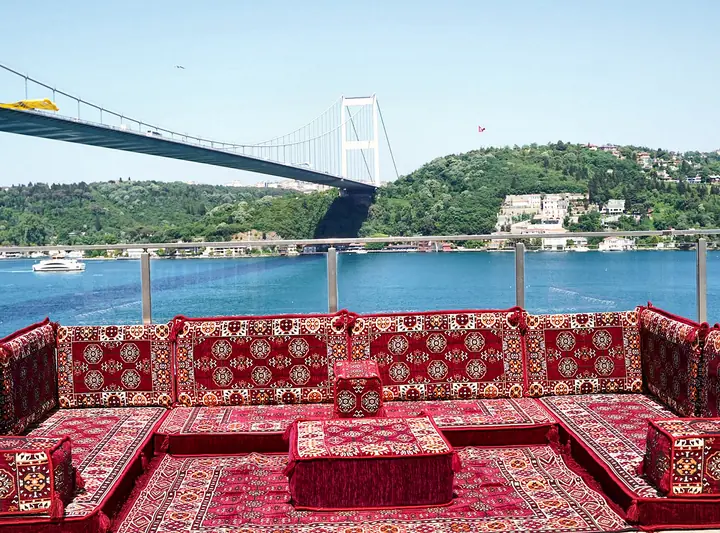
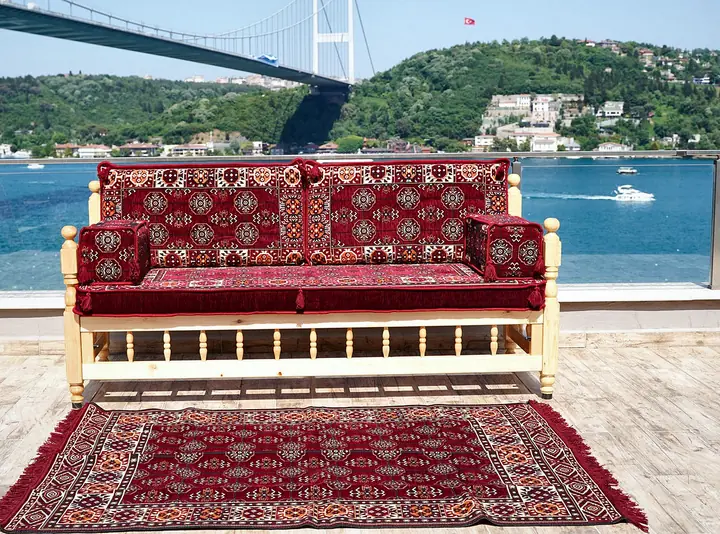
| Maroon | Deep wine red | Octagons in orange, cream and black | Small stars |
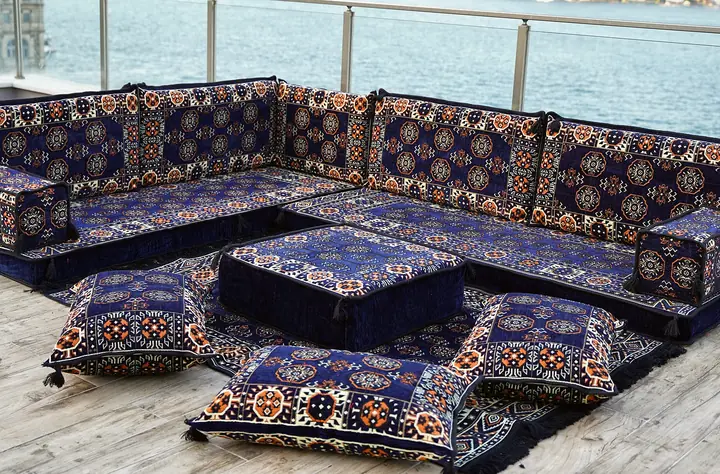
| Navy blue | Deep blue | Octagons in orange and red | Small stars |
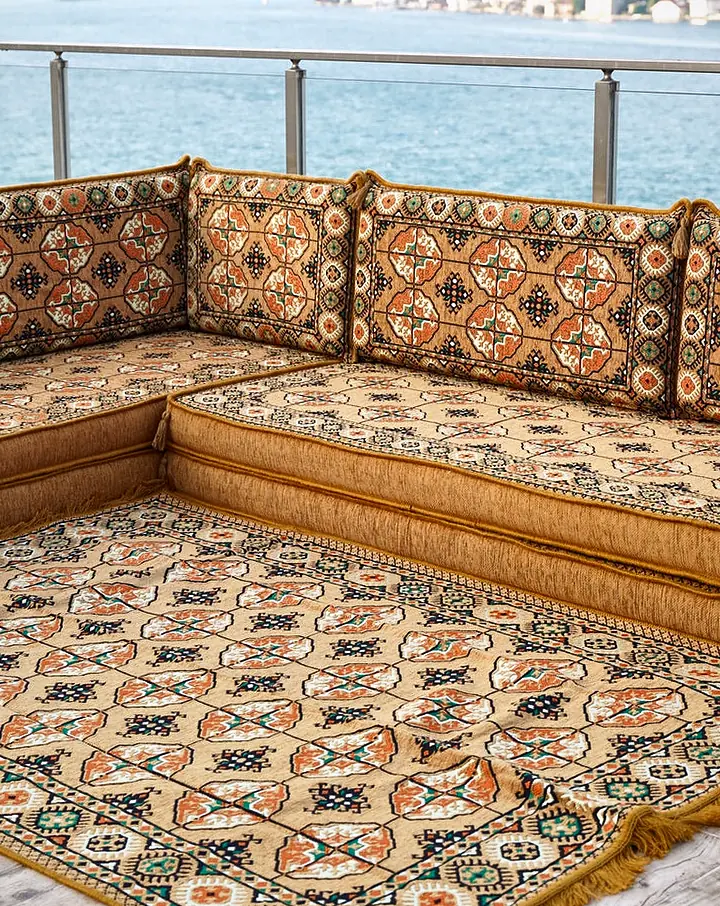
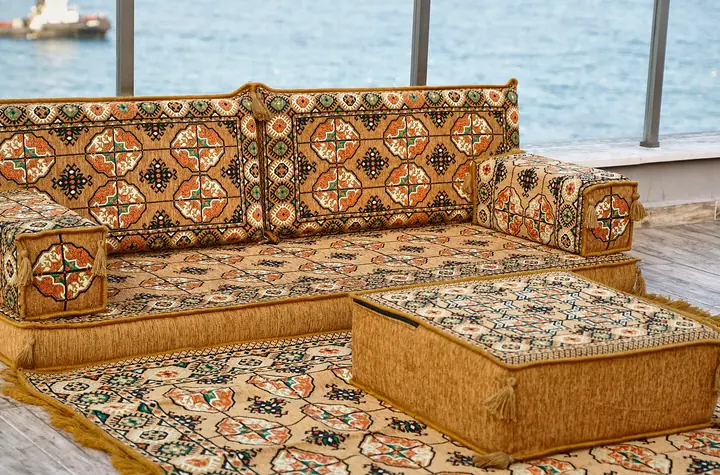
| Gold | Camel gold | Guls split in four: orange, ivory and green | Dark stars |
I would send maroon to a room that wakes up at dusk, because lamplight sinks it into wine and turns the orange octagons into small embers. Navy is steadier, looking much the same at noon as at nine in the evening, and it keeps the red octagons from overheating a sunny room. Gold is the odd one out, since its four-part guls sit best against plain walls.
Ask us about fabric swatches and a foam sample before you order.
Afghan Gul or Afghan toshak: where does the pattern end and the seating begin?
Toshak is the Dari word for mattress, the long floor cushion that runs the length of a wall in an Afghan home, leaned against with bolsters called balesht. Afghan Gul is a pattern, not a seating type. Our sets break that mattress into modules: 75 × 27.5 in (190 × 70 cm) seat cushions, loose backrests and armrests, and seats 4 in (10 cm) to 16 in (40 cm) thick. The traditional form has its own page: Afghan toshak seating.
Which seating comes in the Afghan Gul weave?
Floor sofa sets come in three layouts: one straight run, an L and a U. The sedir bench majlis is a raised version on 75 × 27.5 × 16 in (190 × 70 × 40 cm) wooden benches with the cushion included. For a corner, the Afghan Gul L-shaped set is the usual start. Ask us whether a matching rug is included with your set.
What belongs on the floor and walls beside Afghan Gul?
Think of three rooms: a family living room where the seating hugs two walls, a guest room dressed in the Afghan toshak manner, and a basement den that earns its keep every evening. Where a red rug already anchors the floor, I would pick navy for the seating so the two reds never compete.
For the same wall-to-wall plan in a more formal frame, the Saray pattern is worth a look.
Frequently asked questions
Is Afghan Gul a Bukhara rug under another name?
No. Bukhara is a rug-trade name for a look, and Afghan Gul takes only its octagon-and-field layout. Ask us whether a matching rug is included with your set.
Should I expect hand-woven wool and natural dyes in the Afghan Gul covers?
No. The covers are woven upholstery fabric, and we make no claim that they are hand-woven or naturally dyed. What they borrow from Turkmen and Afghan rugs is the layout of guls, stars and borders, and they are sewn up in our Istanbul atelier.
Why does the gold Afghan Gul look different from the maroon and navy?
On gold, the four quarters of each gul are colored orange, ivory and green against a camel ground. The form is linked with Tekke main carpets, while maroon and navy keep whole octagons with smaller motifs inside.