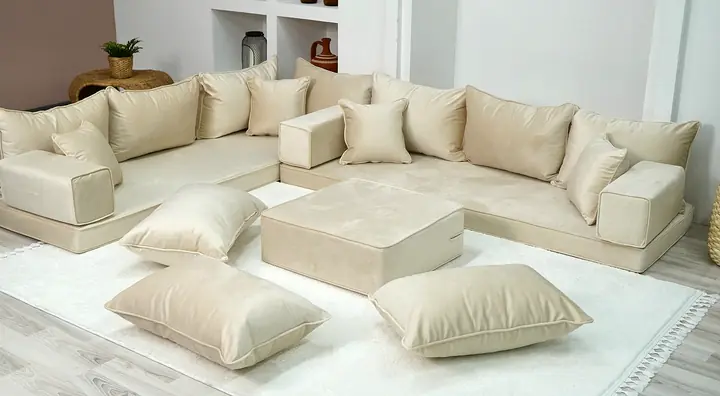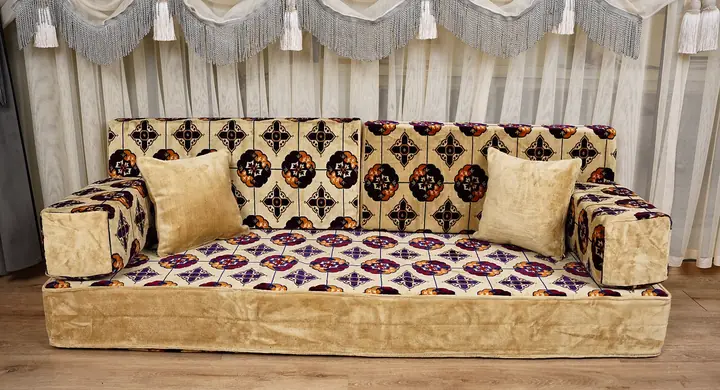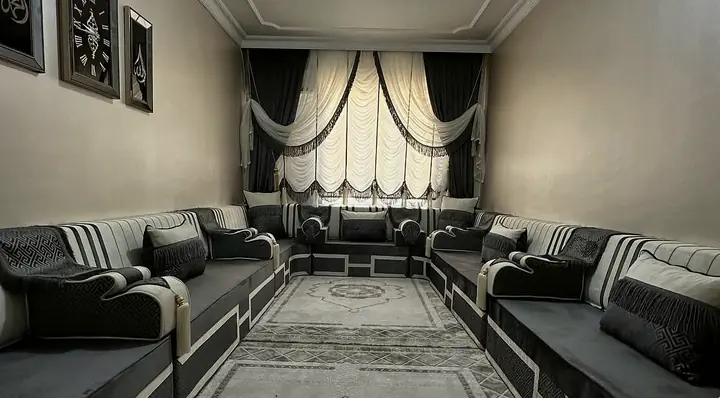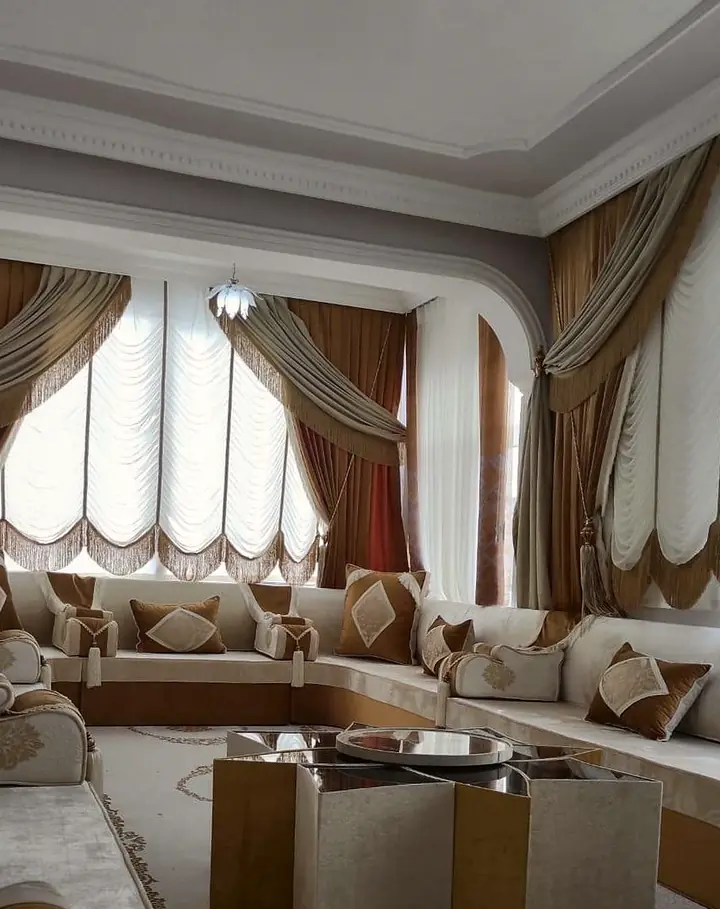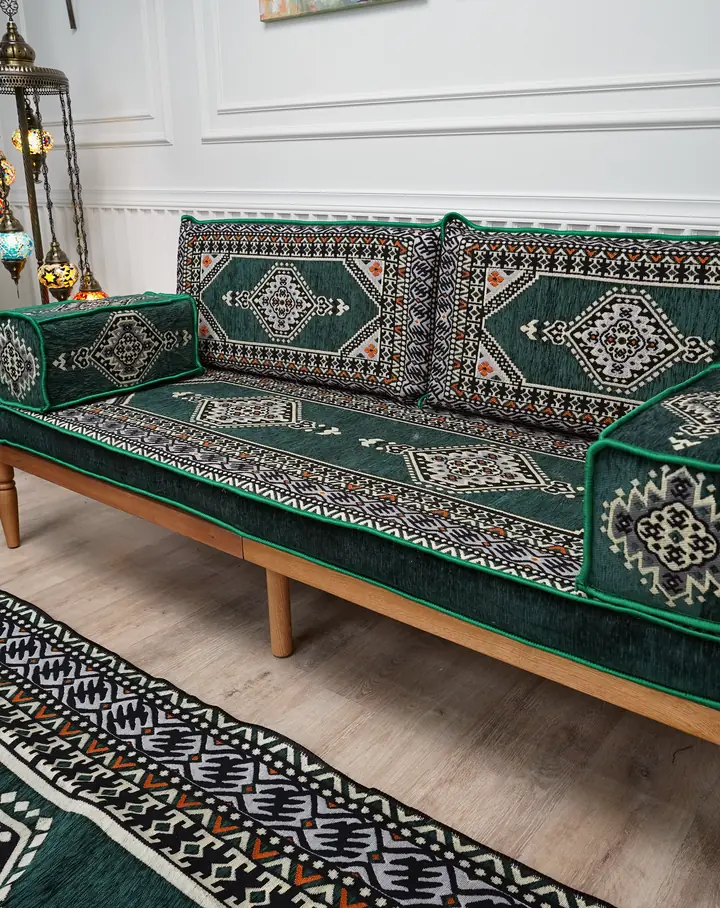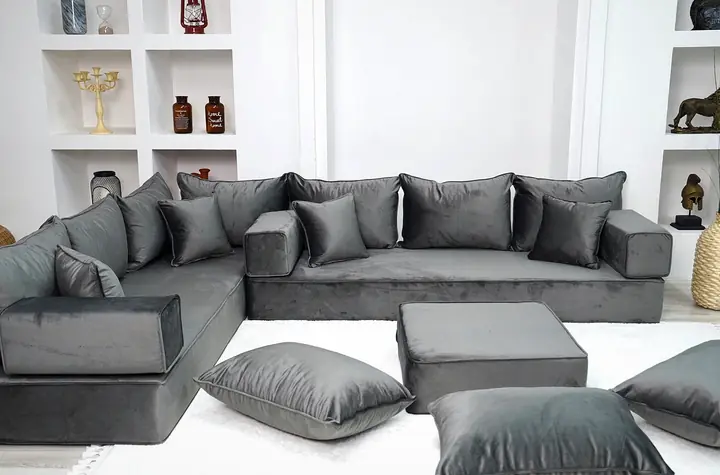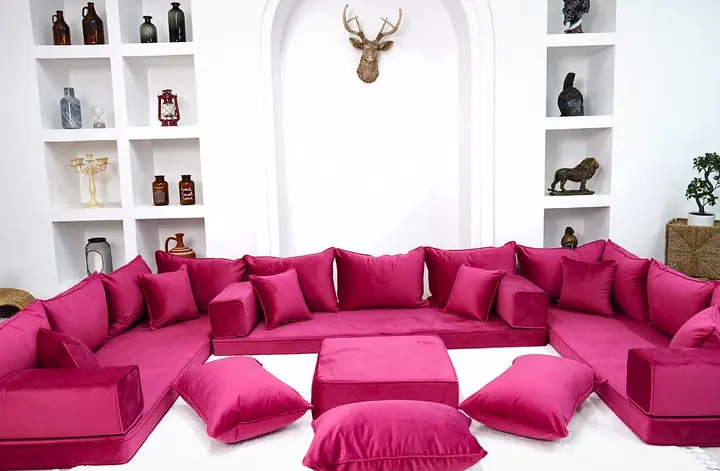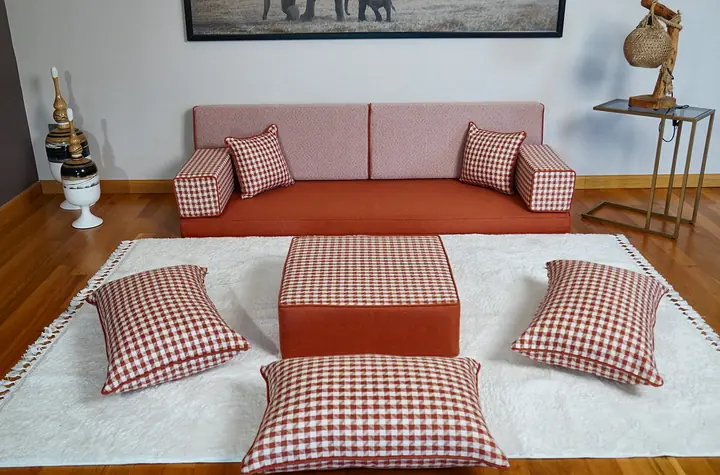
What can everyday care do for majlis fabric, and where does it stop?
Everyday care keeps spills out of the foam and slows fading, but it cannot make a standard cover shed liquid: most majlis covers are upholstery fabrics picked for comfort, so treat them as absorbent. A spill needs a quick hand, and a sunny window needs a plan. Covers unzip, which keeps the foam out of the wash, and the full washing routine, piece by piece, sits in our Arabic sofa care guide.
From the atelier
Questions buyers ask
- How does the fabric on a floor sofa cope with spilled tea or coffee?
- Standard upholstery fabric is chosen for daily sitting rather than for repelling liquids, so treat a cover as absorbent and blot a spill quickly, before it reaches the foam. If spills are part of daily life at home, ask for swatches of a water-repellent fabric before you choose.
- How do I keep the colors even when washing the covers?
- Gentle, cool washing keeps shades even: no warmer than 86°F (30°C), a mild detergent and no bleach, once the care label of your fabric allows a machine wash. Washing the covers of one run together, rather than one cover again and again, keeps neighboring pieces aging at the same pace.
How do you lift a fresh stain from majlis fabric, step by step?
- Lift away anything solid with a spoon or a dry cloth.
- Blot the liquid from the outer edge toward the center.
- Press with a clean, dry cloth until no more color comes off.
- Dab what remains with a damp cloth and a little mild soap.
- Test any cleaner first on a hidden seam or the inside of the cover.
- If the mark is still there, take the cover off and machine-wash it cool.
- Let the cover dry in open air, then zip it back over the foam.
Rubbing drives a spill deeper into the weave, so keep every motion a press. A damp cloth, never a soaked one, keeps water away from the foam and stops a ring from forming.
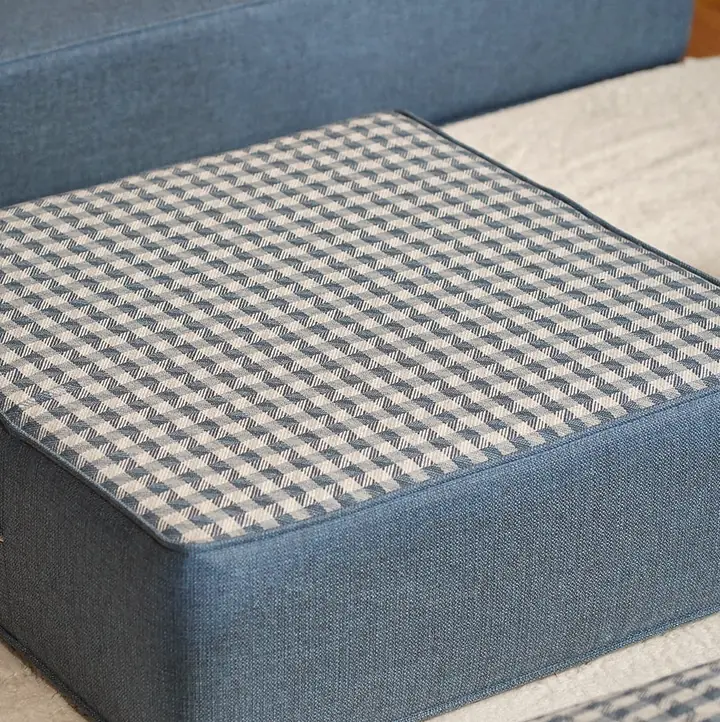
Seven habits make majlis fabric fade or stain faster, and the first is rubbing a spill instead of blotting it from the edge inward.
Which majlis pieces can swap places to keep the color even?
I move cushions around when the seasons turn. Pieces that share a size can trade places, and nobody notices the layout changed.
| Piece | Standard size | Swaps with | Rotation note |
|---|---|---|---|
| Seat cushion | 75 × 27.5 × 4 in (190 × 70 × 10 cm) | Any seat of the same size | Trade the seat under the window for one on a shaded wall |
| Thicker seat | 75 × 27.5 × 8 in (190 × 70 × 20 cm) | Seats of the same thickness | Built as one 8 in (20 cm) block or two 4 in (10 cm) layers |
| Stacked layer | 4 in (10 cm) or 8 in (20 cm) per layer | The layer beneath it | Turn the faded top layer under; 12 in (30 cm) and 16 in (40 cm) seats stack too |
| Backrest | 37.5 × 16 × 4 in (95 × 40 × 10 cm) | Any backrest of the same size | Move window-side backrests to the darker wall |
| Single-set backrest | 35.5 × 16 × 4 in (90 × 40 × 10 cm) | Its twin on the same seat | Swap left and right each season |
| Corner backrest | 23.5 × 16 × 4 in (60 × 40 × 10 cm) | The other corner backrest | Swap corners if one faces the light |
| Armrest bolster | 19.5 × 8 × 8 in (50 × 20 × 20 cm) | Any armrest bolster | Rotate end to end |
| Pouf pillow | 27.5 × 19.5 in (70 × 50 cm) | Any pouf pillow | Wash with the set so shades stay matched |
| Ottoman | 23.5 × 23.5 × 8 in (60 × 60 × 20 cm) | No swap needed | Give it a quarter turn now and then |
Why does sunlight fade majlis fabric, and how do you slow it down?
Light damage adds up and cannot be reversed. Visible light bleaches dyes, while ultraviolet weakens and yellows fibers over time. Museums protect textiles by filtering ultraviolet, keeping light levels low and fitting blinds, screens or window film.
At home, the same tools work. Find the window that sends direct sun onto the seats, and note the hours it does. Draw a curtain or blind across it then, or move the most-used seats away from it. Sun is a slow painter, so keep an eye on the brightest window.
When do the usual majlis care rules change?
| Situation | What changes | What to do |
|---|---|---|
| Water-repellent fabric | Most spills sit on the surface for a while | Still blot quickly; a spill left to sit can mark |
| Patterned indoor fabric used outside | It is woven for indoor rooms | Cover the set, and bring cushions in before rain |
| Faux leather | Wipes clean; plain colors only | Wipe with a damp cloth instead of washing |
| Hot wash or tumble dryer | Heat can shrink a cover | Keep to 86°F (30°C) and air-dry |
| Bleach or strong stain remover | Not for colored covers | Use mild soap and test on a seam first |
| One cover washed far more often | It drifts lighter than the rest | Wash the covers of that run together, as the care label allows |
For terraces, the outdoor majlis range uses a water-repellent fabric, mostly in plain colors. Homes with small children have their own fabric questions, covered in majlis fabric for kids and pets.
Which cleaning habits make majlis fabric fade or stain faster?
- Rubbing a spill instead of blotting it.
- Washing covers hot or tumble-drying them.
- Reaching for bleach on colored fabric.
- Soaking a patch while the cover is still on the foam.
- Washing one cover alone, so it ages apart from its set.
- Leaving the same seat under the sunniest window all year.
- Leaving indoor patterned cushions outside when rain is due.
What does a simple seasonal care routine for a majlis look like?
| When | Task |
|---|---|
| Right after a spill | Blot, dab with mild soap, wash only if a mark stays |
| Every week | Vacuum seats and backrests with a soft brush head |
| When the seasons turn | Swap same-size seats and backrests between sunny and shaded walls |
| End of the hot season | Wash the covers of each run together, cool and gentle, as the care label allows |
| Before choosing new fabric | Compare swatches in your own daylight |
Ask us about fabric swatches and a foam sample before you order. Hold the majlis fabric samples up to your brightest window before you decide. A quick blot today saves a wash tomorrow, and one swap each season keeps the set one color.
Frequently asked questions
Can faded majlis fabric be brought back to its original color?
Faded color does not return, because light damage to dyes builds up and is permanent. The practical fix is new covers; ask the team for covers made without foam. A fresh cover looks brighter beside older ones, so refreshing a whole run at once keeps the shades matched.
Why does spot-cleaning sometimes leave a ring on the fabric?
A ring usually means the patch got too wet. Use a cloth that is damp rather than soaked, work from the edge of the mark inward and let the area dry in open air. If a ring still shows, wash the whole cover so the shade stays even.
Is it safe to dry washed covers in direct sun?
Shade or an indoor airing rack is the better choice. Direct sun adds the same light exposure that fades dyes, and heat from a dryer can shrink a cover until it no longer fits its foam. Zip it back on only when it is completely dry.
Can matching fabric be ordered to remake one worn piece?
Ask the team for matching upholstery fabric by the meter; it comes on 55 in (140 cm) rolls. Expect new fabric to look brighter than covers that have spent a long time in daylight, so a remade piece stands out least on a shaded wall.