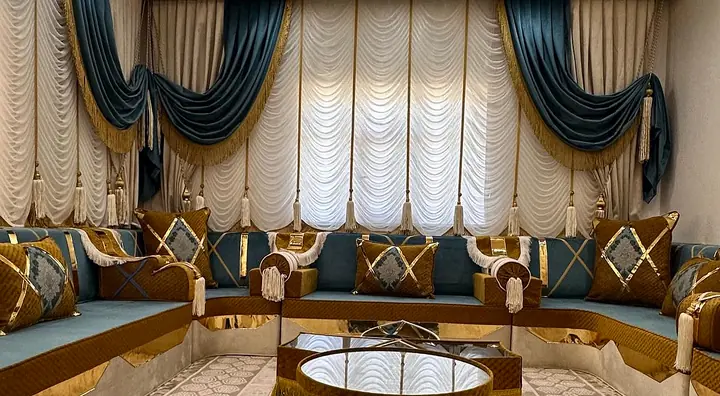
How is hosting in a majlis different from hosting in a living room?
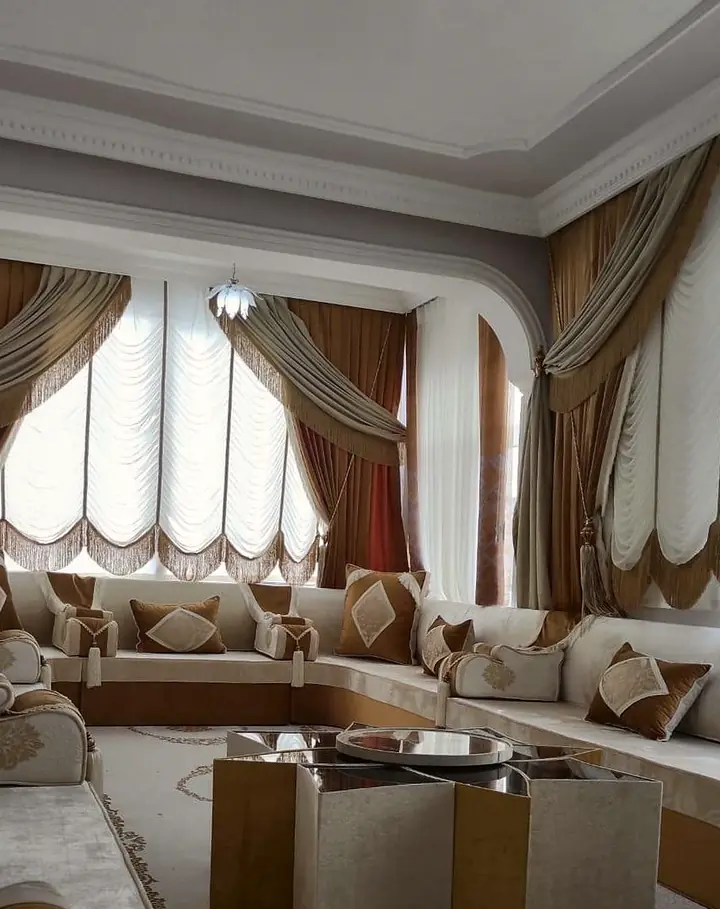
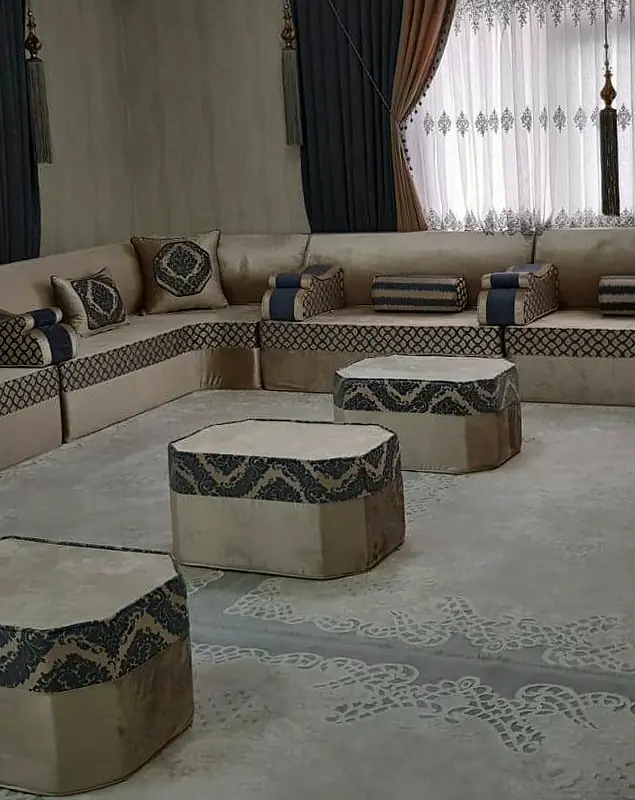
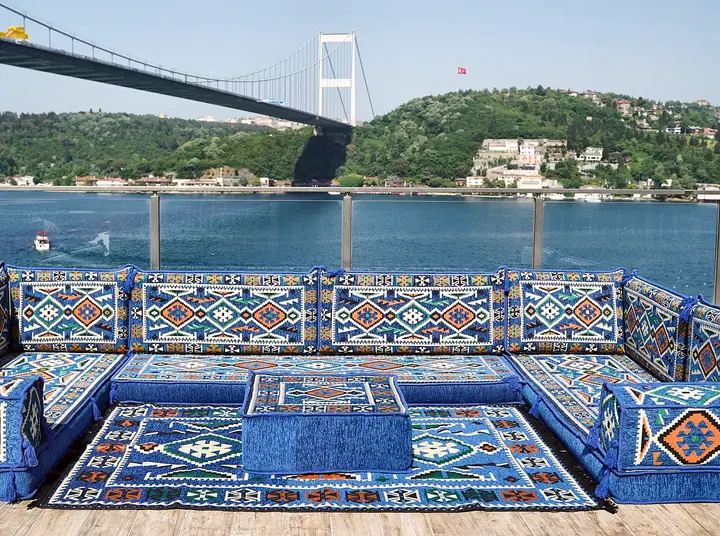
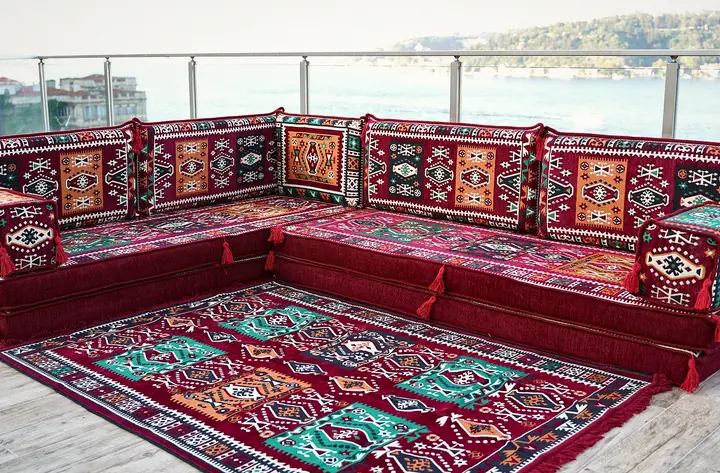
A living room is planned around separate chairs. A majlis is planned around the walls. The seat runs low and unbroken from one corner to the next. The floor in front of it stays clear, so a tray can travel from guest to guest.
That changes the host's job. Nobody is handed the worst chair, because there are no chairs to rank. Everyone faces the middle, so a quiet guest is seen as easily as a loud one. If the word itself is new to you, start with the basics of the majlis, from the low seat to the pieces around it.
From the atelier
Questions buyers ask
- How many guests can one long wall seat at a gathering?
- Each seat cushion is cut to at most 75 in (190 cm) and seats two to three adults. A wall of about 150 in (380 cm) takes two cushions, so four to six guests. Longer walls are split into equal cushions; send each wall length and we count the seats with you.
- Can more seats be added later if the guest list grows?
- Single seat cushions, backrests, corner backrests and armrests can be ordered any time, and so can replacement foam and covers-only sets. Tell us which set you already have and how many extra guests you expect, and ask us about the fabric for the new pieces.
What does UNESCO's majlis listing ask of a host?
UNESCO lists the majlis as a cultural and social space. Its description is plain: carpets on the floor, cushions set against the walls and a fire or stove for coffee and hot drinks. The same listing notes that children who come along with adults learn manners, dialogue and listening there.
I read that as a host's brief. The room is for more than sitting; it is where a visit is taught by example. A hadith in Sahih al-Bukhari gives hospitality its own measure. A guest receives a day and a night of special provision, and food for three days. The customs behind the room, from the coffee pot to the seat of honor, are told at length in The Atelier Journal.
UNESCO inscribed Arabic coffee in 2015, and its order of service still guides hosts: older people and guests first, poured with the right hand.
Tip 1: Which seat should a guest reach first from the door?
In Qatar, the majlis traditionally sits near the entrance. Its low seating lets guests relax with their legs folded. The idea works in any home. A guest should reach a good seat in a few steps, without crossing the room or stepping around trays.
I keep the seat nearest the door clear of bags and coats, with a firm backrest behind it. Older guests settle there without a long walk across the room. Plan the room from the doorway, because that is where every guest first sees it.
Tip 2: How do you set floor seating for a meeting instead of a party?
A party can spread out. A meeting needs every face in view. A U-shaped layout does that well, with the person leading the talk at the closed end and the open side toward the door.
Late arrivals can then join from the open end without walking past the speaker. Keep a low table within reach of each wall for papers and cups, so nobody leans across a neighbor. For a long session I would use two or three walls, not one long row. A row of shoulders is hard to talk to.
Tip 3: Who gets the first cup, and which hand pours it?
UNESCO inscribed Arabic coffee, a symbol of generosity, on its heritage list in 2015. The listing describes coffee served in homes, government offices, weddings and majalis, the plural of majlis. It treats the serving as an act of hospitality. The order is clear. Older people and guests come first, and the coffee is poured with the right hand. A guest gently shakes the cup when they have had enough.
In the Emirates, the welcome begins with coffee and dates before anything else. A National Museum of Qatar story notes that coffee is often prepared in front of the guest, as a sign of respect. So the coffee corner belongs in the room, where guests can watch it being made, not in a kitchen down the hall.
Tip 4: What should sit within the host's reach?
Everything for the first round should sit an arm's length from the host's seat. That means the coffee pot, the small cups, a plate of dates, napkins and a spare tray. Then the host can pour without standing up for every cup.
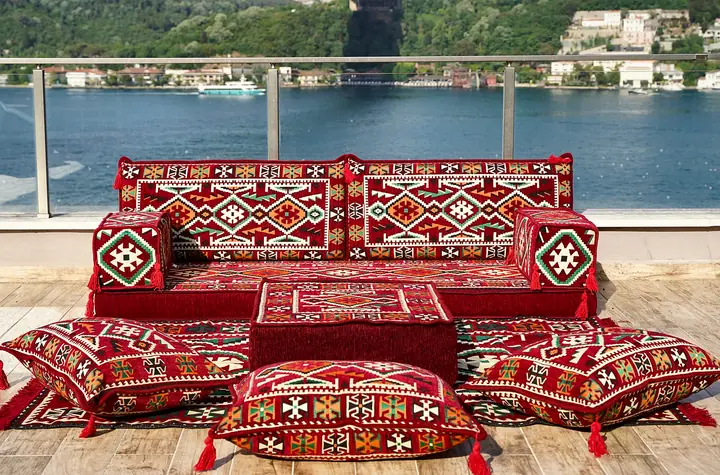
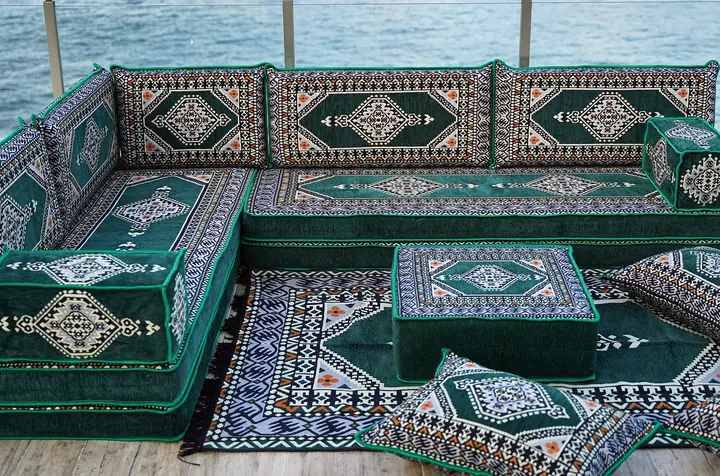
On a floor sofa set, the foam ottoman (23.5 × 23.5 × 8 in (60 × 60 × 20 cm)) does the work of a low table. It is made about 8 in (20 cm) high to match standard seats, so the tray stays close to seated hands.
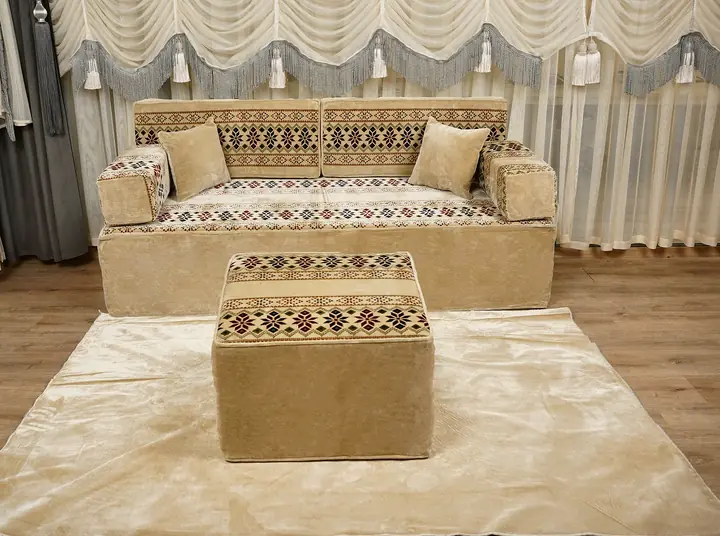
Rugs, lamps and wall pieces matter too, but they can be planned on a quieter day. On the night itself, the tray should never have to cross the room twice.
Tip 5: What can be prepared the day before guests arrive?
Before Eid visits, many Saudi households traditionally set out cushions, coffee pots and pitchers ahead of time. The habit is worth borrowing for any large gathering. A room that is ready the day before leaves the host free to greet people.
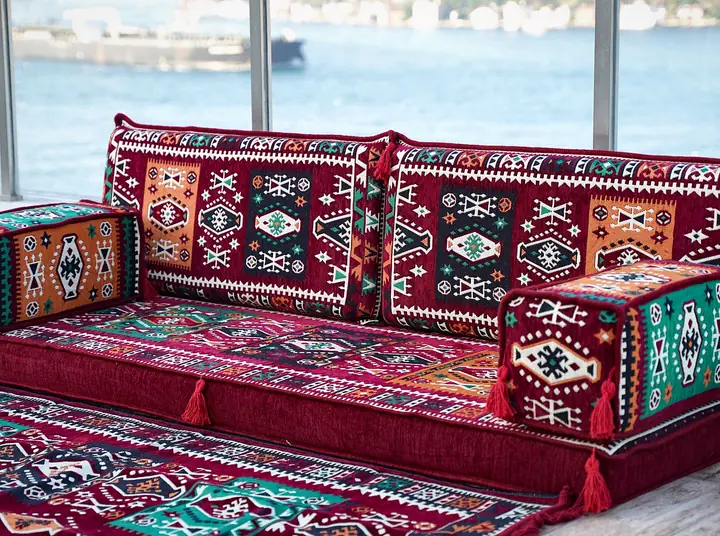
Covers unzip and can be machine-washed on a gentle 86°F (30°C) cycle. Wash them a few days early and let them dry fully. Backrests are separate pieces, which makes it easy to square them against the walls. On a set with stacked cushions, the top layer lifts off and becomes an extra floor mattress if someone stays the night.
How many seats, and how high, for a full house of mixed ages?
Count guests by cushion, not by chair. One seat cushion runs up to 75 in (190 cm); two adults sit on it easily, three when the room fills. A standard L-shaped set seats five or six in comfort, seven at a pinch. Three walls of a U-shaped full set give roughly 224 in (570 cm) of seat. Eight or nine adults sit there comfortably; a bigger gathering needs extra seat pieces.
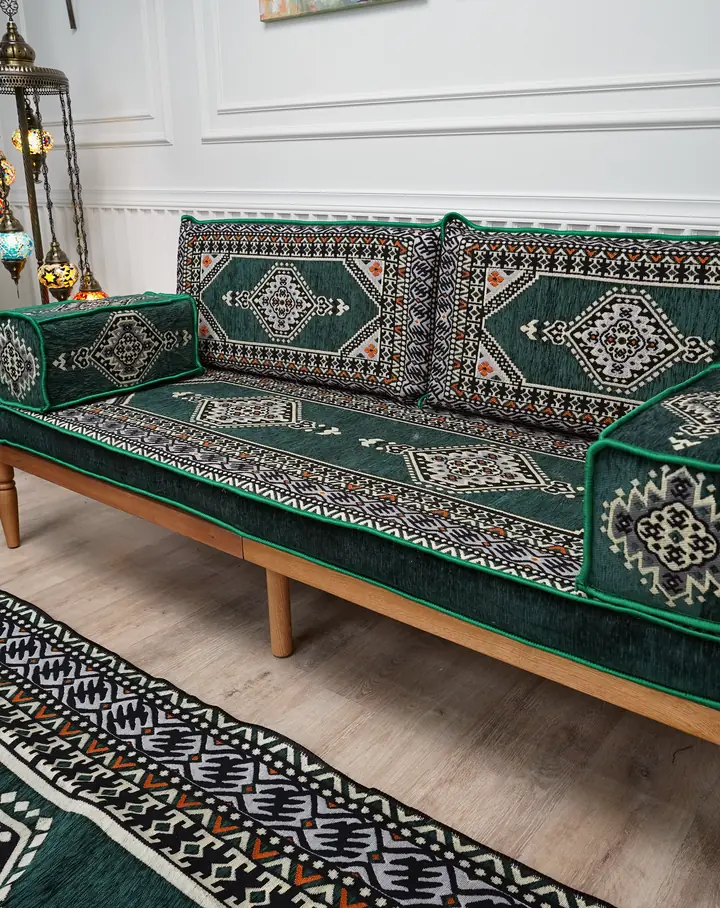
Depth and height decide comfort over a long evening. Floor sofa seats are about 27.5 in (70 cm) deep, with two backrests 16 in (40 cm) tall behind each seat. If older relatives are coming, choose a seat of 12 in (30 cm) or the 16 in (40 cm) sofa-height option. Both are easier to rise from than a classic floor seat, which sits between 4 in (10 cm) and 8 in (20 cm). Full sets already include an ottoman: the L-shaped set comes as 14 pieces and the U-shaped set as 19.
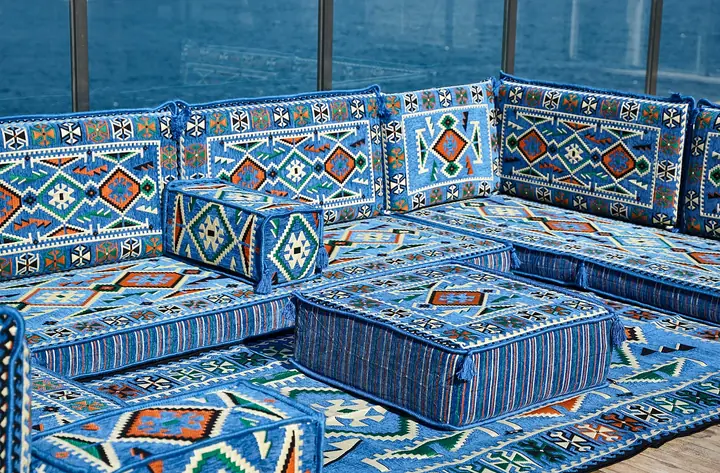
The sets behind these numbers are on our Arabic floor sofa sets page, from a single wall to a full U. For an odd corner or one very long wall, majlis layouts shows how single-wall, L, U and full-room plans fit a room.
Before the doorbell, walk the room once as a guest would.
- At the door: the first seat is clear, with a backrest behind it.
- Along the walls: cushions meet without gaps, and backrests stand square.
- In the middle: the ottoman or a low table is in reach from every wall.
- At the far corner: the last seat is as easy to reach as the first, with no tray in the path.
Frequently asked questions
What does it mean when a guest gently shakes the coffee cup?
The shake is a polite signal that the guest has had enough. UNESCO's description of Arabic coffee service records it alongside two other courtesies: older people and guests are served first, and the coffee is poured with the right hand. The host takes the cup and stops refilling.
Can one majlis room serve both family visits and work meetings?
It can, because the seating itself does not need to move. For family visits, keep the middle open and the coffee corner in view. For a meeting, place a low table within reach of each wall and seat the person leading the talk at the closed end of the U.
Where should the host sit when guests are over?
We suggest a seat near the door and close to the coffee corner. From there the host can stand to greet each arrival, pour without crossing the room and notice an empty cup, while the deeper, quieter seats stay with the guests.
Sources
- UNESCO, Majlis, a cultural and social space
- UNESCO, Arabic coffee, a symbol of generosity
- Visit Qatar, The majlis
- Visit Abu Dhabi, Emirati food and coffee
- National Museum of Qatar on Google Arts & Culture, Qatar's culinary journey
- Sunnah.com, Sahih al-Bukhari 6135 (hospitality to the guest)
- Saudipedia, Eid al-Fitr celebrations in Saudi Arabia