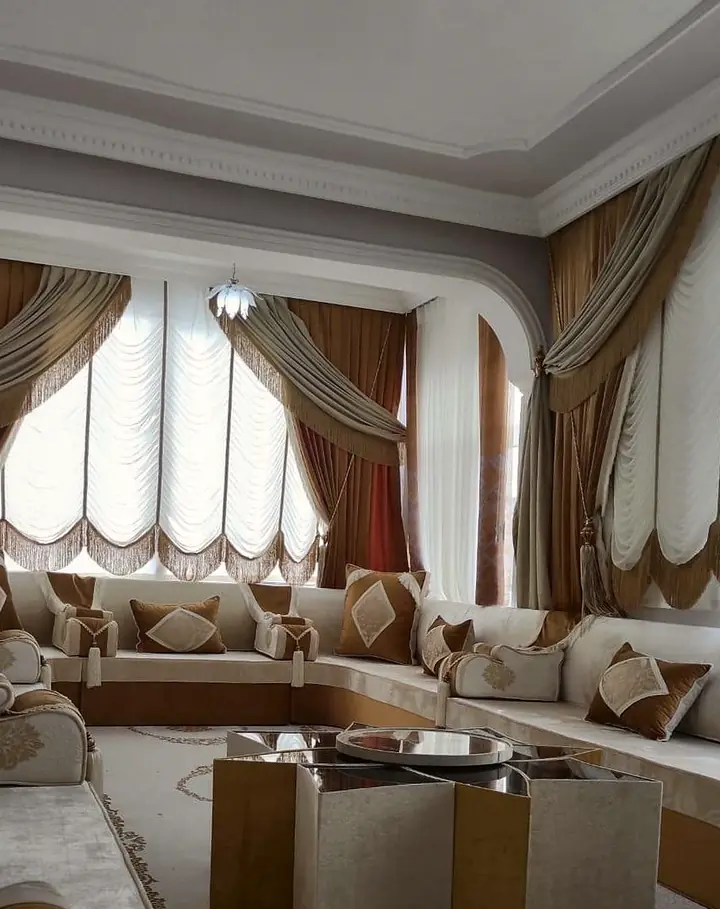
What shape does a Ramadan evening take, from sunset to suhoor?
Of all the gatherings in our Atelier Journal, a Ramadan night keeps the majlis in use the longest, from sunset into the small hours. A well-known hadith describes breaking the fast with fresh dates, dry dates or a few sips of water, so many hosts set those out before sunset, with prayer and the full meal to follow. Taraweeh prayers come after the night prayer, and in Qatari tradition the month holds three meals: suhoor before dawn, iftar at sunset and the late-night ghabga.
From the atelier
Questions buyers ask
- How far ahead should I order a majlis so it arrives before Ramadan?
- Production and transit both have to fit before the first iftar, with room to spare. Production time depends on your layout and the season — ask us for the current schedule. Ready-made sets are packed soon after payment — ask us for the current dispatch time. Share your date before paying so the team can check that it is realistic.
- Ramadan is only two or three weeks away. Which majlis or floor sofa options can still make it in time?
- With so little time left, ready-made floor sofa sets and the everyday 4 in (10 cm) or 8 in (20 cm) thickness are the likeliest to arrive, because they are made ahead in standard sizes. Ready-made sets are packed soon after payment — ask us for the current dispatch time. A wooden majlis or a thick custom build rarely fits such a short window. Made-to-order sets take a little longer than ready ones — ask us for the current timing.
How do you seat an iftar for family and guests at home?
In many homes the iftar room is set twice in one evening, first for the meal and then for the long sit that follows it. Low seating handles both without moving a single chair: the cloth or tray goes down in the middle, and once the plates are cleared the same cushions become the place for tea and talk. A quick look around before sunset settles most of it:
- Dates and a jug of water within arm's reach of the first seats, ready for the moment the fast ends.
- A clear way from the kitchen door to the middle of the room, because the dishes keep coming once prayers are over.
- Prayer rugs folded near the seats, so guests can pray in the room and come straight back to the meal.
- Tea glasses and a low table waiting at each corner for the long sit after the meal.
- One soft lamp lit, with the ceiling light saved for clearing up.
Floor seating around a sufra or low tables: what spacing works?
Many families still eat iftar on a sufra (a cloth spread on the floor), with the cushions around it serving as seat and backrest at once. Spacing runs in two directions. Along the wall, allow about 23.5 in (60 cm) of seat for each guest, so one 75 × 27.5 in (190 × 70 cm) floor cushion takes two or three adults. In front, seats are about 27.5 in (70 cm) deep, so the cloth can start where the seat ends and nobody leans far for a plate.
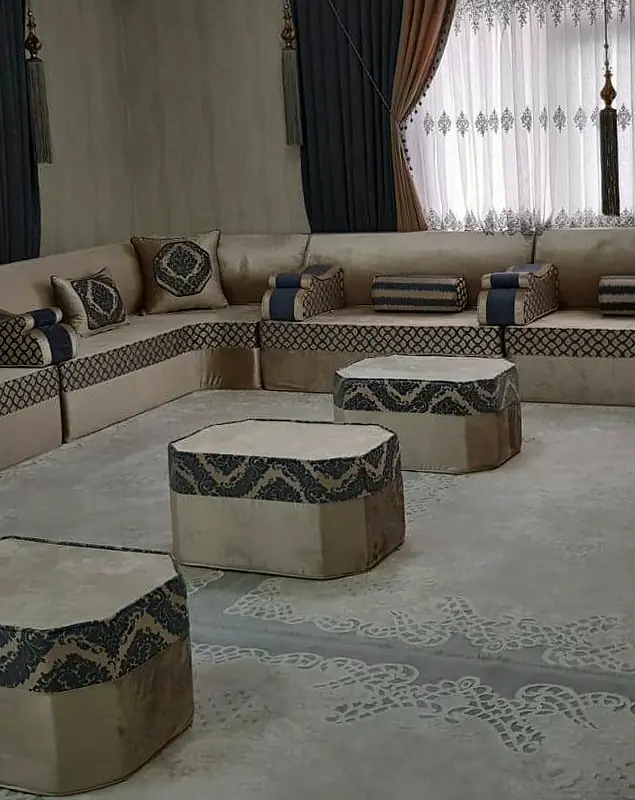
When the meal moves to tables, keep their height in step with the seats: the ottoman table is about 8 in (20 cm) high on standard sets and up to 16 in (40 cm) beside a raised majlis, and the foam ottoman measures 23.5 × 23.5 × 8 in (60 × 60 × 20 cm). A longer room needs more landing places, such as one large center table with four side tables or a nesting set of 5, 7 or 9 pieces.
Coffee keeps its own etiquette. UNESCO notes that in Arabic coffee service the older people and guests are served first, with the coffee poured using the right hand, so a side table at the elders' end of the room keeps the dallah where it is needed.
Which colors, lamps and lanterns set a Ramadan room?
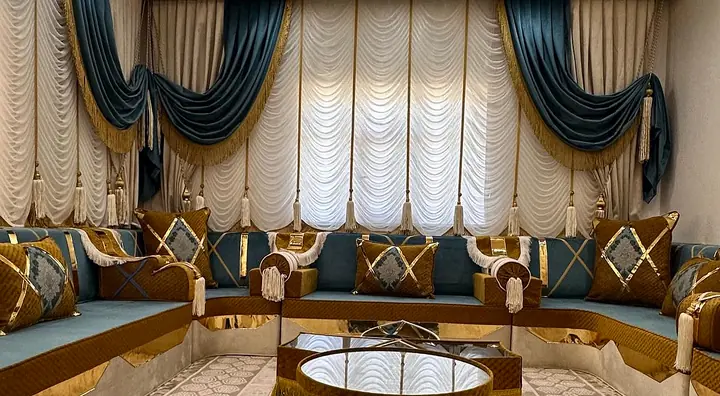
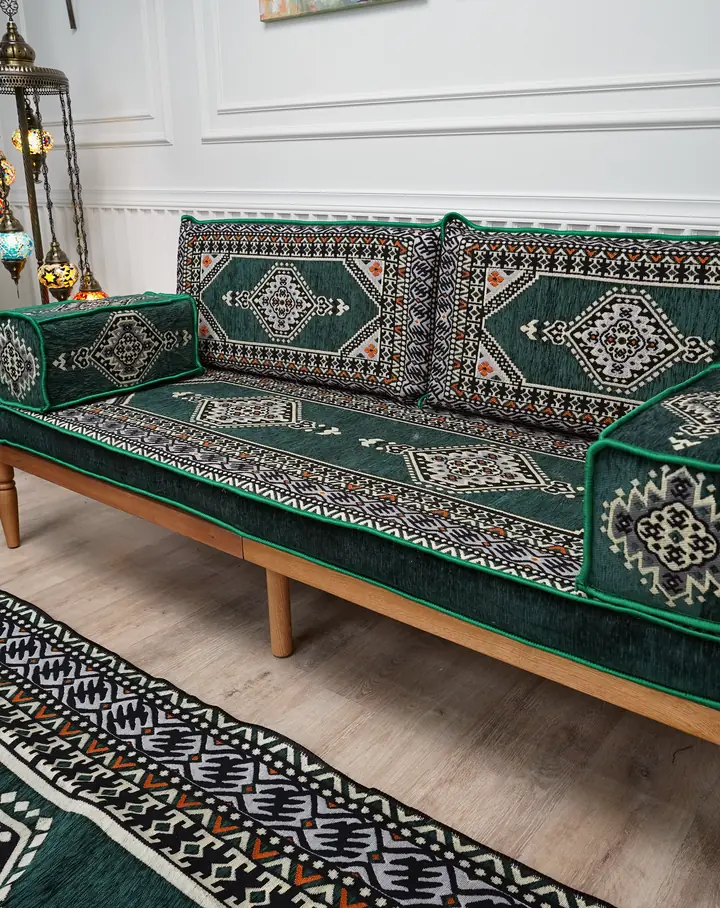
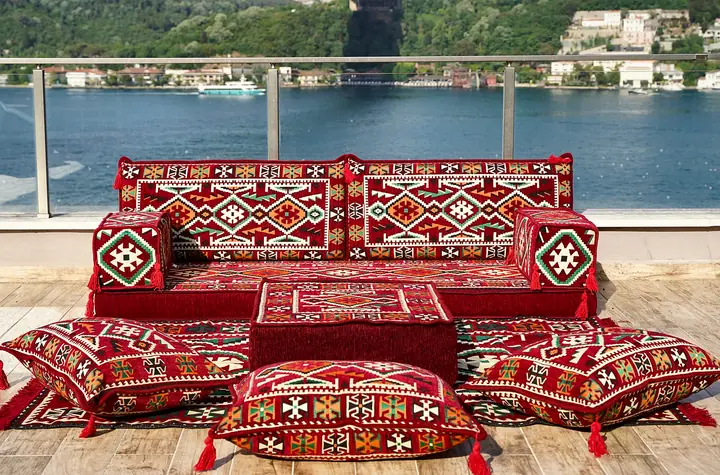
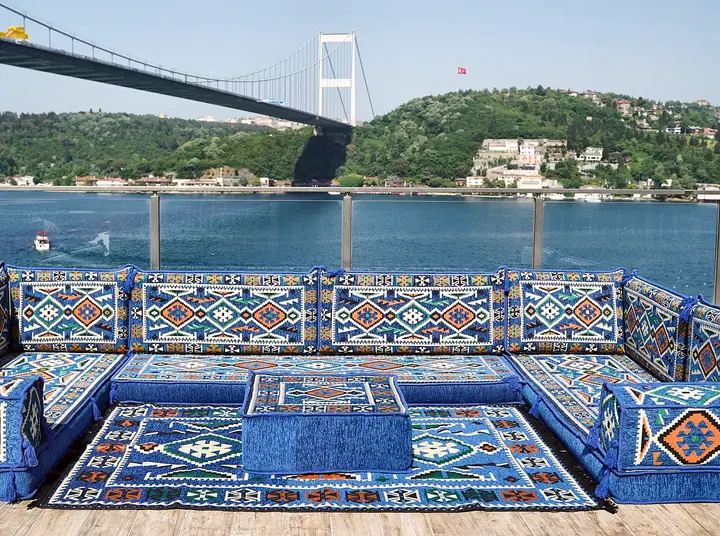
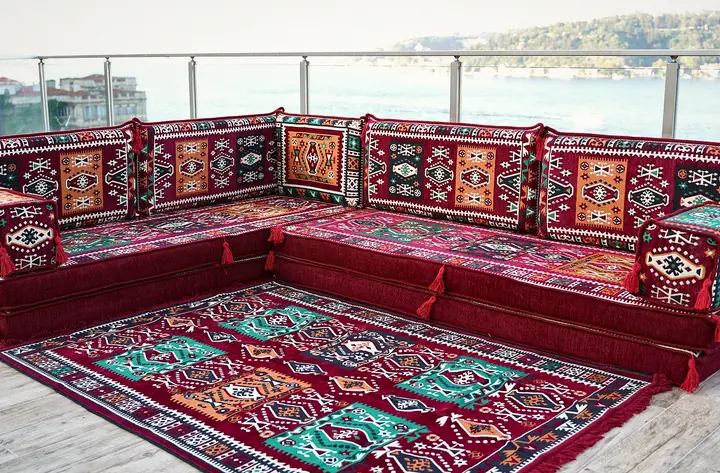
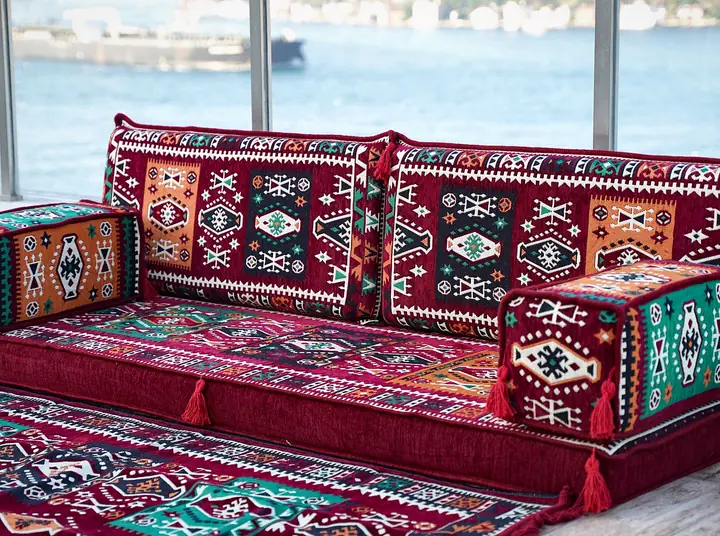
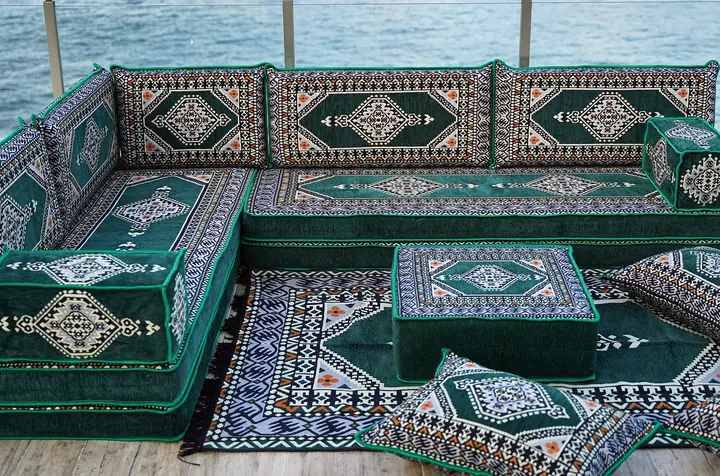
Deep, warm colors carry the month well. Burgundy, golden yellow and emerald green look rich under evening light, and on an ivory or beige majlis they can arrive as cushion covers and throws, so the room changes for Ramadan without new seating.
Light matters as much as color. A widely told story links the fanous (the Ramadan lantern) to crowds who carried lanterns to welcome a Fatimid caliph into Cairo during the holy month. Turkish mosaic lamps do similar work at seat level, where a pool of colored light from one corner feels gentler than a bright ceiling. I find a majlis looks most like itself after iftar, when the main light goes off and only the lamps stay on.
Which seat height suits elders through a long Ramadan night?
Long evenings are hardest on the knees. Relatives who find low seats hard to rise from do better on 12 in (30 cm), and at 16 in (40 cm) a raised majlis sits at about the height of a regular sofa, while 4 in (10 cm) to 8 in (20 cm) suits a classic floor-style room. Children seldom last until the end of the evening. On a stacked seat the layers are separate pieces, not sewn together, so the top one can come off and be laid on the rug as a bed for a sleeping child. Ramadan nights are long, so the backrests had better be generous.
After a month of evenings, the covers unzip and can be machine-washed on a gentle 86°F (30°C) cycle, which leaves the room fresh for the visits of Eid.
How many guests fit on an L or U at iftar, once the corners are counted?
The fullest night of the month, often the evening the wider family comes, is the one to size the room for. Each seat cushion is at most about 75 in (190 cm) long, and on an L or U the cushion on the second wall is shorter by one seat depth, about 27.5 in (70 cm), because the first run already fills the corner.
| Layout | Seating run | Seated for the meal | Tightly seated | Pieces in the full set |
|---|---|---|---|---|
| Single wall | 75 in (190 cm) | 2 to 3 | 3 | 10 |
| L-shape | 150 in (380 cm) | 5 to 6 | 7 | 14 |
| U-shape | 224 in (570 cm) | 8 to 9 | 9 | 19 |
How much seating does a community iftar need?
Many mosques and community groups host a shared iftar through the month, and UNESCO describes iftar traditions as shared meals that strengthen family and community ties and encourage charity. In a hall the seating question is the same as at home, only longer.
Count the wall run, not the chairs. At up to three guests a cushion, six 75 in (190 cm) seats in a row cover about 449 in (1140 cm) and take as many as 18 people, and a longer wall simply takes more pieces. Halls that bring the same seating out each Ramadan will find buying and storage advice under majlis seating for organizations and events.
What does iftar look like in Qatar, Türkiye and homes abroad?
In Qatar the end of the fast is still marked by a cannon fired at sunset, now carried on television, and shops and cultural venues come alive after iftar. UNESCO has inscribed iftar and its socio-cultural traditions for Azerbaijan, Iran, Türkiye and Uzbekistan, with prayers, music, storytelling and games gathered around the shared meal.
Far from the Gulf, the room is often smaller than the guest list, and the evening adapts: one wall of seating, cushions carried in from other rooms, a cloth spread down the middle. Ready Arabic floor sofa sets come in single, L and U layouts, which suits an apartment where the iftar room is also the everyday living room.
When should you order so a new majlis arrives before Ramadan?
Work back from the first iftar you plan to host, not from the first day of the month. Planning around Ramadan, Eid or a wedding? Tell us your date when you ask for a quote and we'll confirm what's achievable. Production time depends on your layout and the season — ask us for the current schedule. Transit to your country is a separate stage that follows production.
When you write to the atelier, open the message with the date of that first iftar, ahead of the wall lengths, so the team can check the schedule against it before any fabric is chosen.
Frequently asked questions
What is the difference between iftar and suhoor?
Iftar is the meal that breaks the fast at sunset, often begun with dates and water before the full dinner. Suhoor is the lighter meal eaten before dawn, ahead of the day of fasting. In Qatari tradition a late-night ghabga falls between the two.
Can the iftar room stay set up for Eid?
Most of it can. The seating and tables that served iftar suit Eid visits too, so many families simply wash the covers, swap in brighter cushions and clear more floor for the daytime visits that Eid brings.
Will a custom majlis be ready in time for Ramadan?
It will when the weeks left cover both production and transit. Production time depends on your layout and the season — ask us for the current schedule. If the date is too close for that, a ready floor sofa set is the safer choice for the first iftars.
Sources
- Sunnah.com, Sunan Abi Dawud 2356 (breaking the fast)
- Visit Qatar, Ramadan traditions
- Google Arts & Culture, National Museum of Qatar: Qatar's culinary journey
- UNESCO, Iftar/Eftari/Iftar/Iftor and its socio-cultural traditions
- UNESCO, Arabic coffee, a symbol of generosity
- Wikipedia, Fanous
- Wikipedia, Iftar