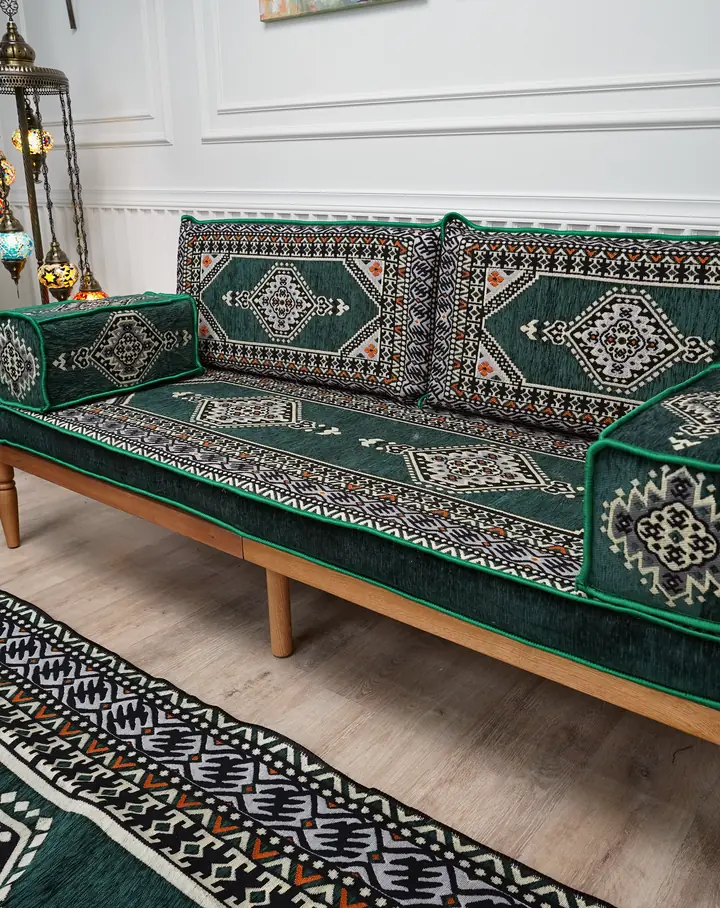
What is majlis lighting, and why does it sit lower than in a sofa room?
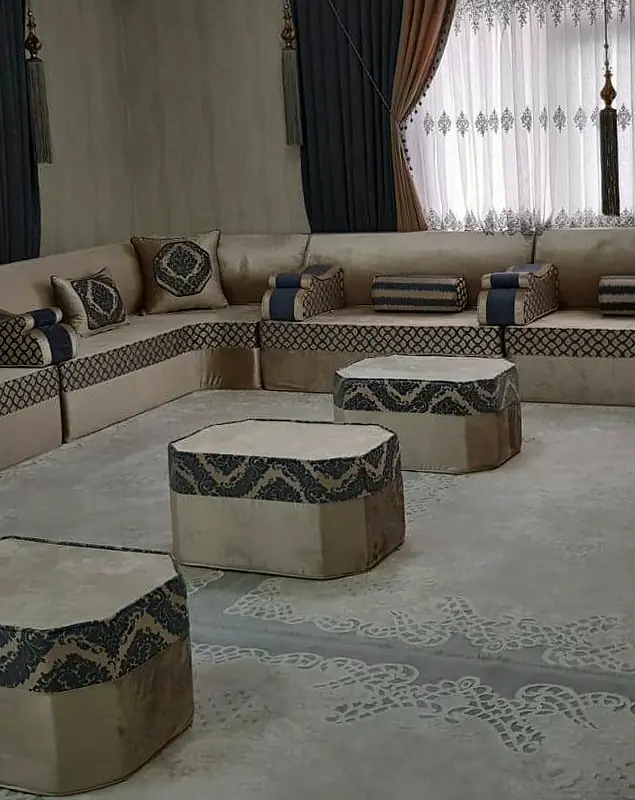
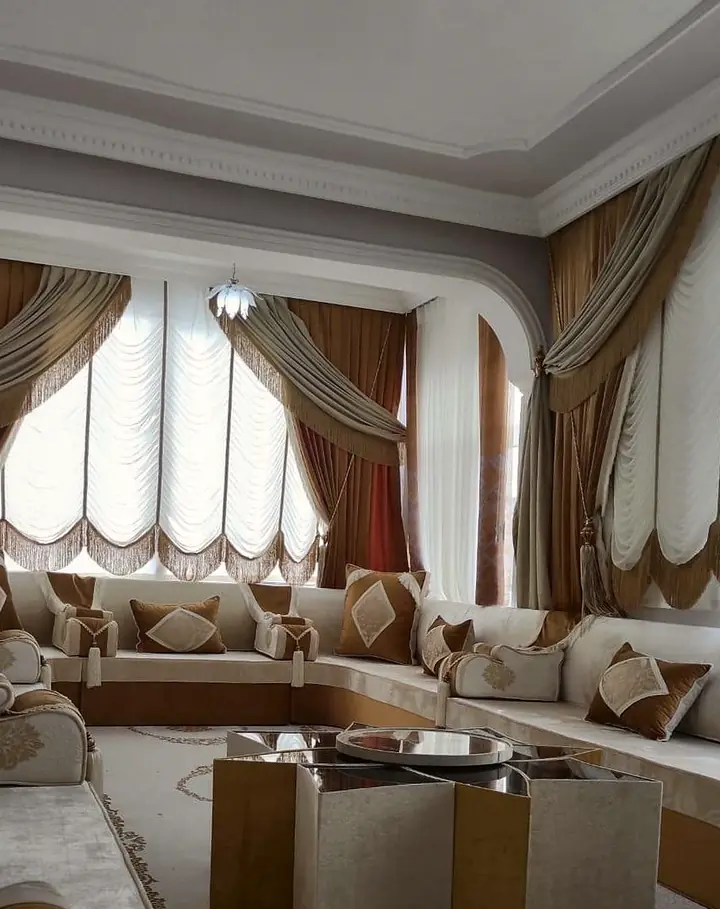
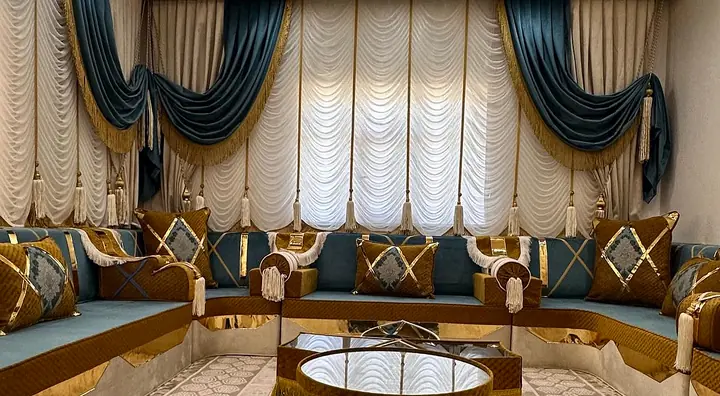
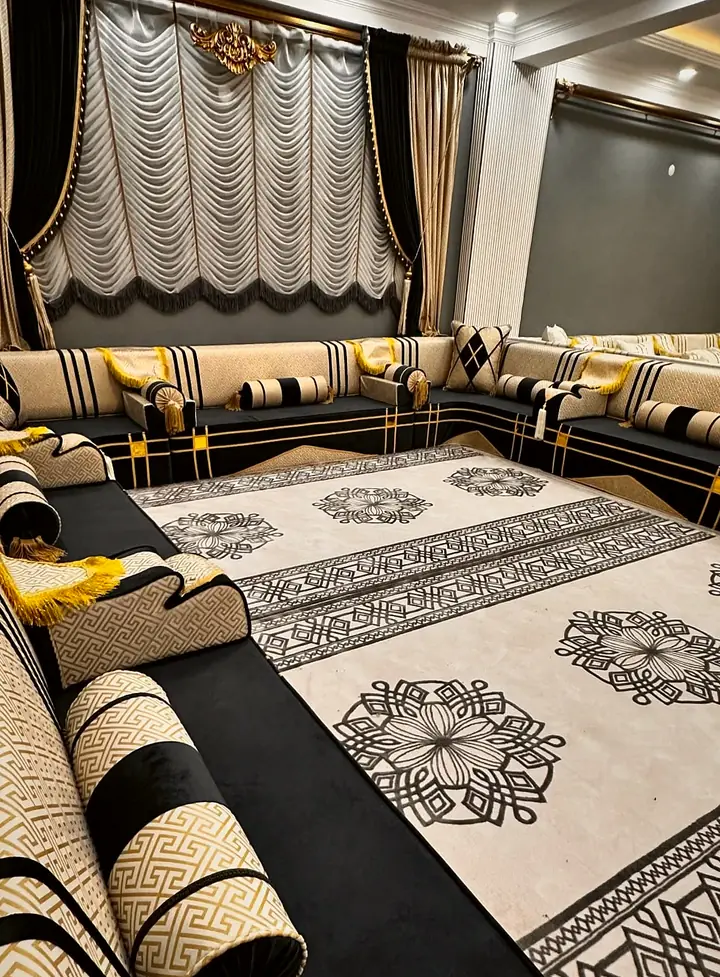
On a sofa the eyes sit roughly level with a lamp on a side table, but guests in a majlis sit on seats 4 in (10 cm) to 16 in (40 cm) high, so a ceiling fixture lights the room from the wrong side of the people in it. Majlis lighting brings the source down to them: table lamps on low side tables, a floor lamp at the end of a run, a lantern on a tray. Anyone new to the low, wall-hugging layout can start with what a majlis is and how it is arranged. Low light suits a low room.
From the atelier
Questions buyers ask
- Besides the seating, can I add lamps, rugs or other decor so the majlis room matches?
- Decor pieces can be ordered alongside the seating: mosaic lamps, including floor lamps with a cluster of glass globes on one stand, and kilim rugs that match some majlis patterns. Lamp designs change with stock, so send a photo of the one you like and we confirm it is available.
- I want to make sure the yellow isn't too bright. Can I see the real fabric?
- Before production the team can film the real fabric in daylight, so you judge the shade on the cloth itself rather than on a catalog photo. Name colors carefully, because maroon is darker than red, and cream, beige and gold vary from one fabric to the next.
How did mashrabiya screens and lanterns turn light into pattern?
The name mashrabiya is generally traced to an Arabic root meaning to drink, because water jars were kept in the lattice to cool in the passing air. The fanous (a Ramadan lantern) is usually described as made mostly of metal and glass and once lit by a candle or oil, and later craftsmen worked tin and colored glass into pierced patterns that throw shadows across the walls. A modern echo stands over the Louvre Abu Dhabi, opened in November 2017, whose dome is often described as 7,850 metal stars in eight layers. Lanterns, screens and the rooms they lit come up again and again in our stories on majlis craft.
The Louvre Abu Dhabi dome is often described as 7,850 metal stars in eight layers, light turned into pattern, the same idea as a mosaic lamp.
Mosaic glass or pierced metal: which kind of patterned light suits your room?
A mosaic lamp glows through many small pieces of colored glass, so it scatters soft spots of color rather than sharp shadows. A pierced-metal lantern works the other way, throwing stars and lattices of shadow through holes cut in the metal. Glass suits a room where the seat fabric is plain and the walls are pale, since the colored spots become the pattern. Metal suits a patterned majlis better, because its shadows carry no color of their own and add no second palette. I reach for glass in a velvet room and for metal beside a kilim weave.
Which bulb color flatters velvet, chenille and gold trim?
Bulbs sold as warm white come closest to the old incandescent glow, and the warmer the bulb, the more amber the room. Under that light deep reds and greens look fuller and gold thread reads as gold rather than as a flat yellow, while cool white bulbs tend to flatten the same fabrics. Under warm bulbs ivory turns to honey, and under cool ones it drifts toward gray. The bulb already in your lamp is a fairer judge of a swatch than any screen.
Candles near cushions: how much clearance does a flame need?
The NFPA, the US fire protection association, advises keeping candles at least 12 in (30 cm) from anything that can burn, never leaving them unattended and considering flameless candles, and it notes that home candle fires peak in December. In a majlis, where cushions, curtains and a rug all sit within reach of the tray, that distance runs out quickly. Battery tea lights inside a lantern give much the same glow through pierced metal or colored glass. A real flame belongs on a metal tray on a table, well away from the backrests and the curtain hems.
Where do lamps go along an L or U majlis?
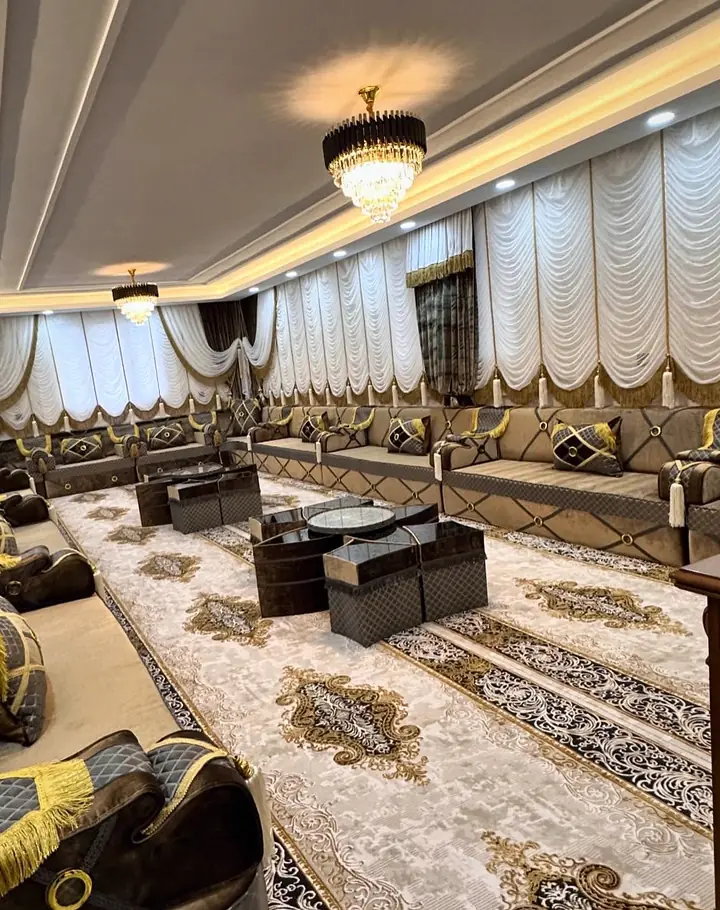
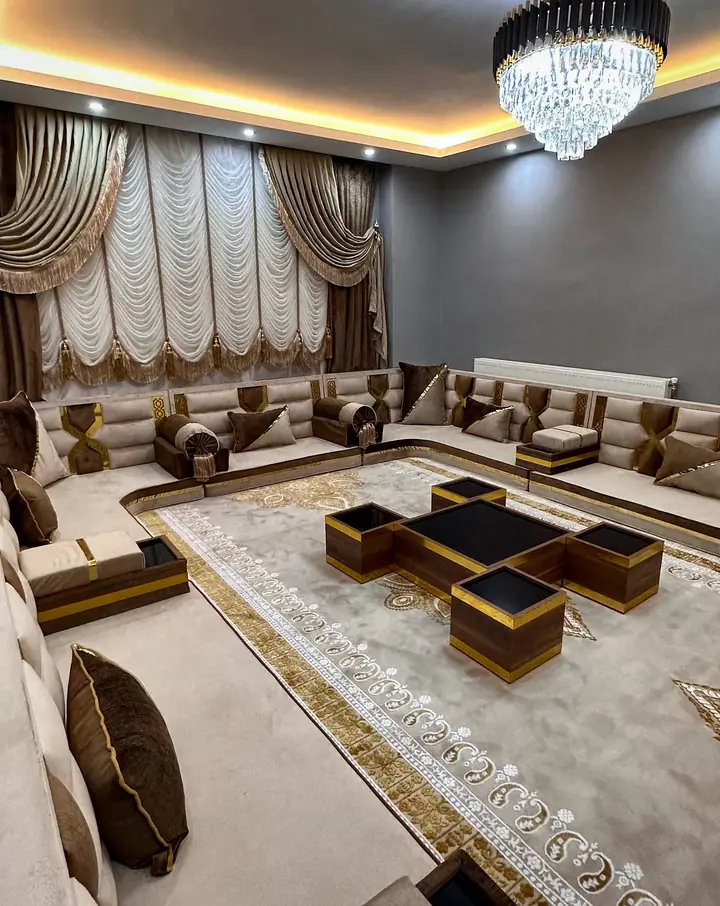
Plan the lamps from the seating plan. A U-shaped set runs about 224 in (570 cm) along three walls, with sides of about 75 in (190 cm), 130 in (330 cm) and 75 in (190 cm), and each corner where two runs meet is closed by a 23.5 × 16 × 4 in (60 × 40 × 10 cm) corner backrest. Those corners are the natural lamp positions, since one lamp there lights two runs at once and stands where no one leans. Backrests rise 16 in (40 cm) above the seat, so a table lamp on a low side table should throw its glow just over them, and a tall floor lamp belongs at an open end rather than behind a backrest.
- One lamp in each corner where two runs meet, on a side table or on the floor.
- A smaller lamp at any open end of the seating, close to the door.
- A lantern with a battery light on a metal tray in the middle of the room.
- Warm white bulbs throughout, so every lamp shows the fabric in the same color.
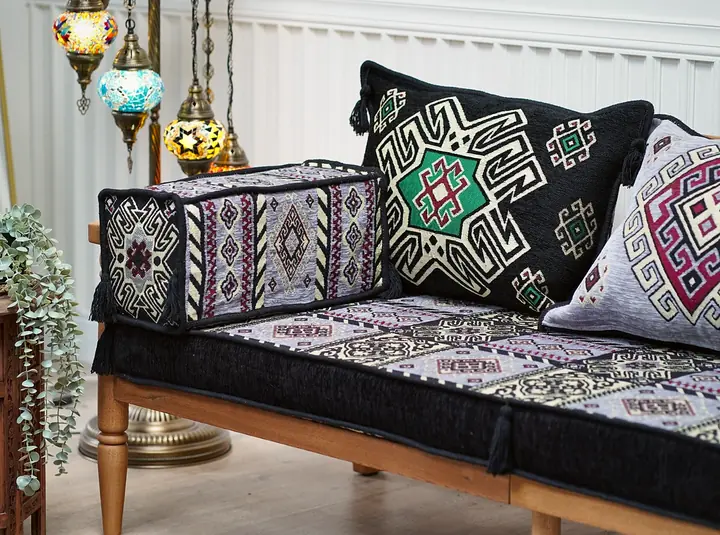
For the lamps themselves, see mosaic glass lamps for tables, floors and ceilings, and for the cloth under them, how velvet, chenille and linen take the light.
My favorite test of a lit majlis is the tea tray: if the glasses throw a little color onto it and every face around it is easy to see, the lamps are in the right places.
Frequently asked questions
Why does a majlis fabric look darker in the evening?
Evening light is weaker and usually warmer than daylight, so deep colors lose detail first and pale ones shift toward cream. The fabric itself has not changed, only the light falling on it. A lamp beside the seat, rather than one overhead, brings back most of the color.
How many lamps does a U-shaped majlis usually need?
Three is a good start for a U-shaped set: one in each of the two corners where the runs meet and a smaller one near the open side or the door. A longer room, or seating on all four walls, adds a lamp for each extra corner.
Is a Ramadan fanous the same as a Turkish mosaic lamp?
They are different crafts. A fanous is a metal and glass lantern that once held a candle or oil, often with pierced tin that casts shadows, while a mosaic lamp glows through many small pieces of colored glass and scatters soft spots of color.