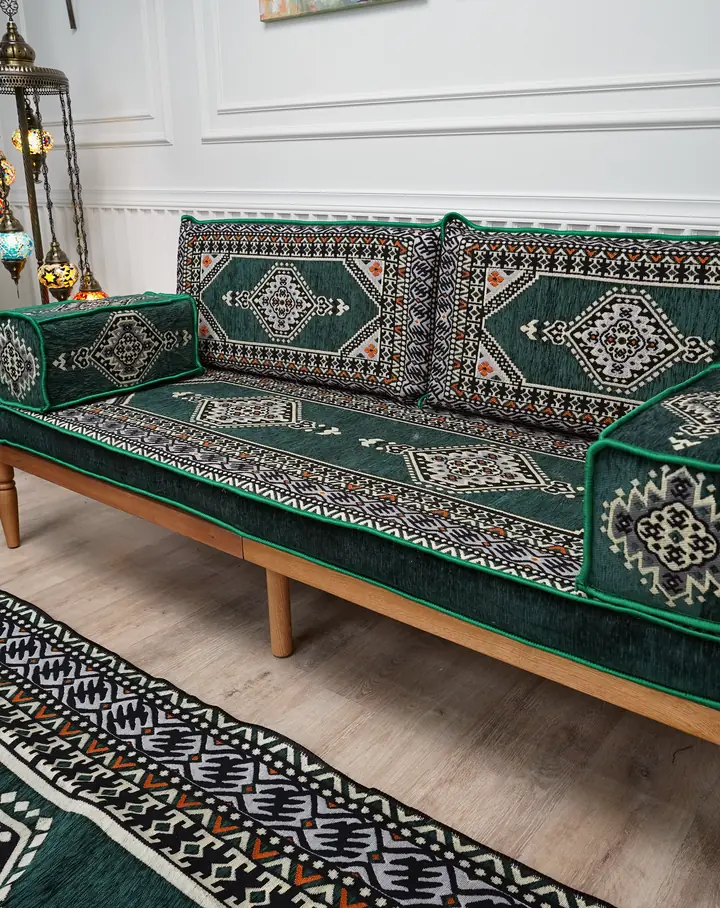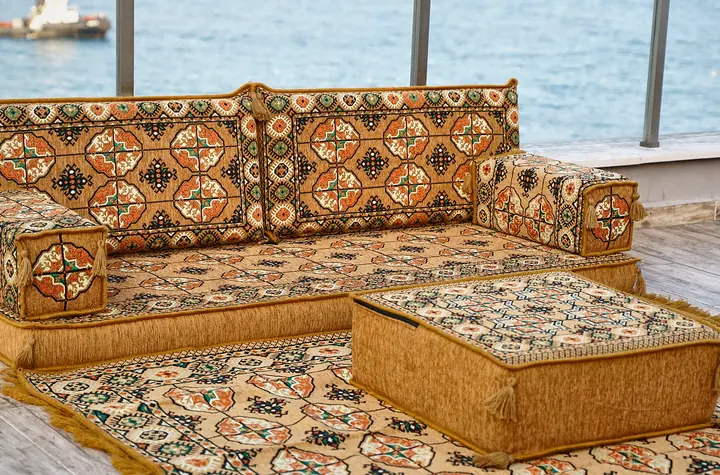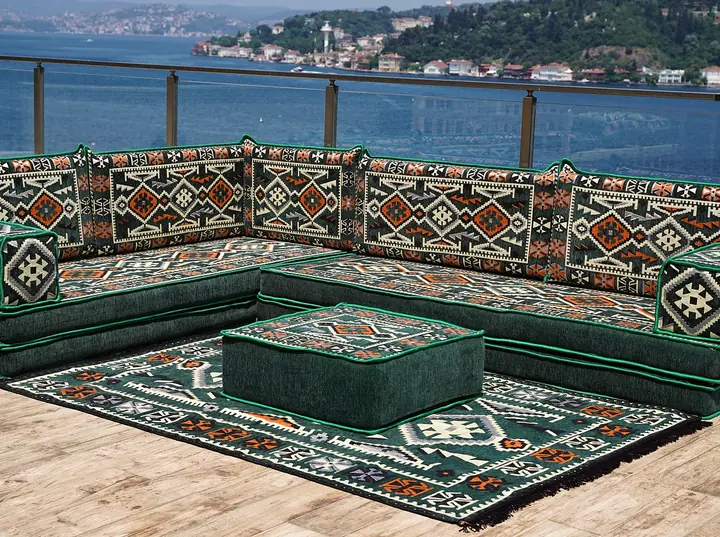
Why is thickness the same number as seat height on a floor sofa?
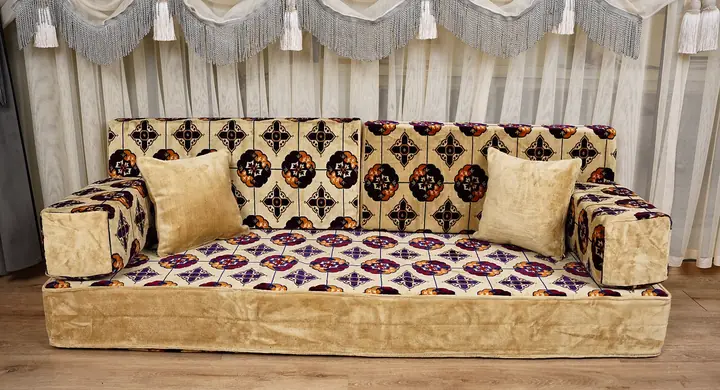
Under its cover, a floor sofa seat is foam and nothing else. Standard seats are cut to 75 × 27.5 in (190 × 70 cm), with no frame or legs beneath them. The number you order as thickness is therefore the height you sit at. A wooden bench works differently. Its frame does part of the lifting, and bench plus cushion stands about 16 in (40 cm). Lengths, depths and layouts for each room are collected in our guide to majlis sizes by room.
From the atelier
Questions buyers ask
- Are the 4, 8, 12 and 16 thickness options in inches or centimeters?
- The steps are in inches, so 4, 8, 12 and 16 mean 4 in (10 cm), 8 in (20 cm), 12 in (30 cm) and 16 in (40 cm). Read the 16 as centimeters and the real seat looks about two and a half times too tall. Each option on a product page lists its converted size.
- Why does the 8 in (20 cm) set list twice as many seat cushions as the 4 in (10 cm) set?
- Each seat in the 8 in (20 cm) version is usually two 4 in (10 cm) cushions stacked. The 4 in (10 cm) L-shaped set therefore has two seat cushions, and the 8 in (20 cm) L-shaped set has four. Backrests, armrests and pillows stay the same. The itemized piece list for your option shows which build you are getting.
- If I choose 4 in (10 cm) cushions, will I feel the hard floor underneath?
- On tile or wood you may feel the floor slightly through a 4 in (10 cm) cushion, because the foam layer is thin. Many families still choose it for the low, classic look. For a softer seat that is also easier to rise from, 8 in (20 cm) or more is the step most people notice.
Which checks settle the right thickness before you order?
- Measure the seat height of a chair or sofa your household already finds comfortable, from the floor to the top of the seat.
- Compare that number with the four steps: 4 in (10 cm), 8 in (20 cm), 12 in (30 cm) and 16 in (40 cm).
- Note who will sit there most often, and whether anyone finds rising from a low seat hard.
- Check the floor, because tile or wood under a 4 in (10 cm) seat feels firmer than carpet.
- Choose one solid block or stacked layers for any seat of 8 in (20 cm) or more.
- Write the thickness and the build on your order, and make sure the confirmation repeats both.
I trust the chair test more than any photo. A seat height you already live with is a number nobody has to guess.
How does each thickness sit, and who is it for?
Seats of 4 in (10 cm) and 8 in (20 cm) are the everyday choices. The 12 in (30 cm) and 16 in (40 cm) seats are usually made to order. Thickness is a decision about how you sit down and stand up, not only about looks.
| Seat | How it sits | Who it suits |
|---|---|---|
| 4 in (10 cm) floor seat | Close to the rug, and a hard floor can be felt slightly | Prayer rooms, low tables and a classic floor room |
| 8 in (20 cm) floor seat | Fuller and softer, and easier to get up from | Family rooms and long evenings |
| 12 in (30 cm) floor seat | Halfway between floor level and sofa level | Mixed ages and guests who stay for hours |
| 16 in (40 cm) floor seat | About the seat height of a regular sofa | Older relatives and formal sitting rooms |
| Raised majlis, 14.5 in (37 cm) to 16 in (40 cm) depending on the model | Chair-like, with full backrests along the wall | Rooms that want sofa-level seating |
| Wooden bench set, about 16 in (40 cm) including the cushion | Raised on a solid pine frame | Rooms that want a framed, raised look |
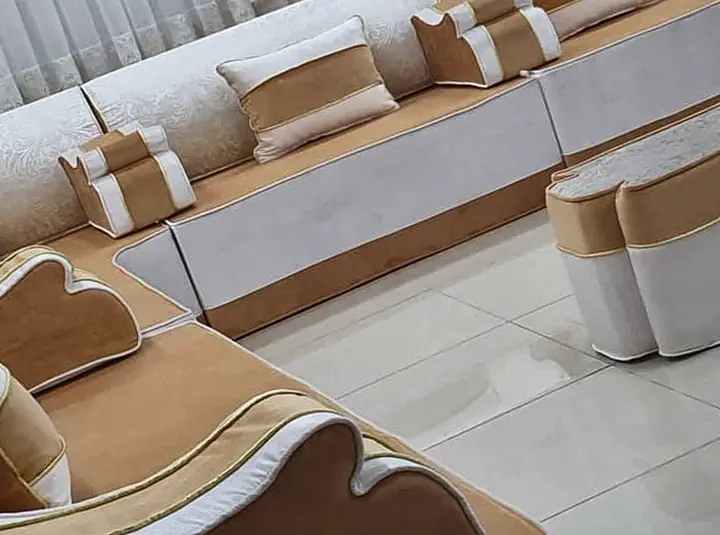
Is the 8 in (20 cm) seat one solid cushion or two stacked 4 in (10 cm) layers?
It can be either, and the order should say which. Most ready sets build it from two 4 in (10 cm) layers, often written 4+4. A solid block is the other option, cut as one piece. Height and footprint come out identical. What changes is handling. Layers lift apart into spare floor seats, while a solid block keeps one even surface. I like layers in homes that host big gatherings.
| Seat | Made as | Good to know |
|---|---|---|
| 8 in (20 cm), stacked | Two 4 in (10 cm) layers, each in its own cover | Seat cushions double on the piece list, so an L full set reads 16 pieces and a U reads 22 |
| 8 in (20 cm), solid | One foam block | Ask for it by name and check that the confirmation says single layer |
| 12 in (30 cm) | Usually one solid block | Stacking 8 in (20 cm) on 4 in (10 cm) tends to slide; a later raise with an extra layer works, but a new 12 in (30 cm) set is best cut as one block |
| 16 in (40 cm) | One block, or two layers of 8 in (20 cm) | Equal layers can later serve as two lower seats |

When does the usual thickness advice change?
| Situation | What changes | What to ask for |
|---|---|---|
| Tile or wood floor | A 4 in (10 cm) seat lets the hard floor through slightly | 8 in (20 cm) or more |
| Older relatives or stiff knees | Low seats are harder to rise from | 12 in (30 cm), or the 16 in (40 cm) sofa-height step |
| Prayer room or low tables | Staying close to the floor matters more than softness | 4 in (10 cm) to 8 in (20 cm) |
| Low window sill | Backrests stand 16 in (40 cm) tall on top of the seat, so a taller seat lifts them too | Measure the sill before choosing 12 in (30 cm) or 16 in (40 cm) |
| Ottoman or low table | The standard ottoman is 8 in (20 cm) tall | A matching height for 12 in (30 cm) or 16 in (40 cm) seats |
| Raising a set later | One more 4 in (10 cm) layer turns 8 in (20 cm) into 12 in (30 cm) | Extra layers in the same fabric and pattern |
Thickness sets the height. The foam inside sets how the seat pushes back. Seats use high-density polyurethane foam — ask us for the exact density for your build. Our page on sponge and foam quality explains how that foam is chosen.
Which thickness mistakes lead to the wrong set arriving?
- Reading 4, 8, 12 and 16 as centimeters when the steps are in inches.
- Treating thickness and seat height as two numbers on a floor set, or as one number on a wooden bench.
- Ordering the 8 in (20 cm) seat without saying solid block or stacked layers.
- Opening one box of a stacked set and judging the thickness from it.
- Picking 4 in (10 cm) for a room where older guests sit through long evenings.
- Raising the seats without checking the ottoman height and the window sill.
What should the order say before the foam is cut?
Three lines on the confirmation prevent most thickness surprises: the thickness in both units, the build, and the ottoman height. I check them in that order.
| Line on the order | Example entry |
|---|---|
| Seat thickness | 8 in (20 cm) |
| Build | Two stacked 4 in (10 cm) layers |
| Seat size | 75 × 27.5 in (190 × 70 cm) |
| Ottoman | Standard 23.5 × 23.5 × 8 in (60 × 60 × 20 cm), or raised to suit taller seats |
| Seat foam | The foam named on the confirmation |
Before the order goes through, press the foam with your own hand. A sample box with fabric and foam lets you do that at home. The Arabic floor sofa sets page shows the standard single, L and U layouts.
Frequently asked questions
Which measurements distinguish seat height from backrest height?
Seat height is measured from the floor to the seating surface, while the backrest adds its own height above that surface. Compare those two dimensions on the selected build rather than reading the overall profile as the thickness of the cushion.
Should different seating runs use the same specified height?
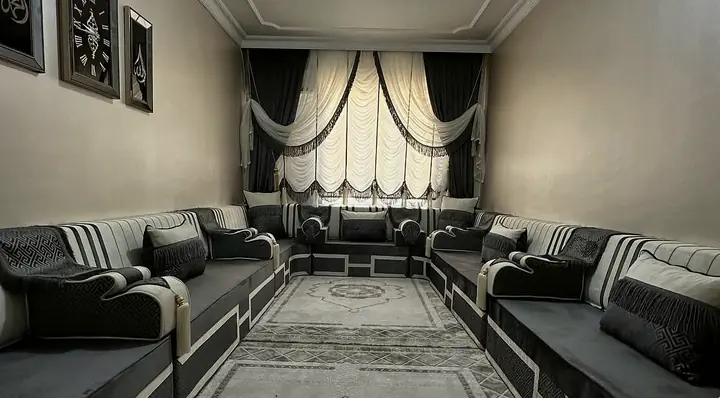
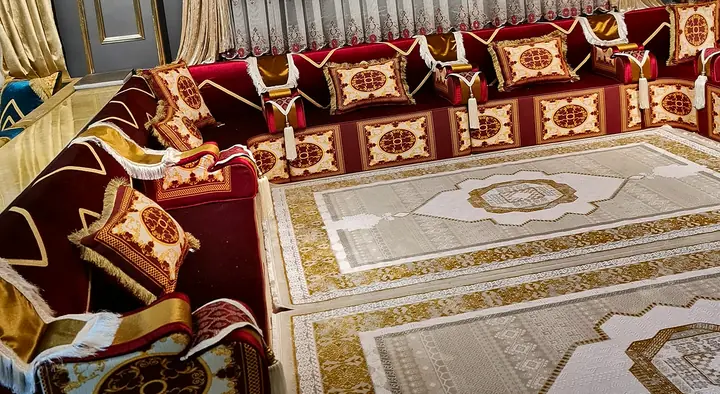
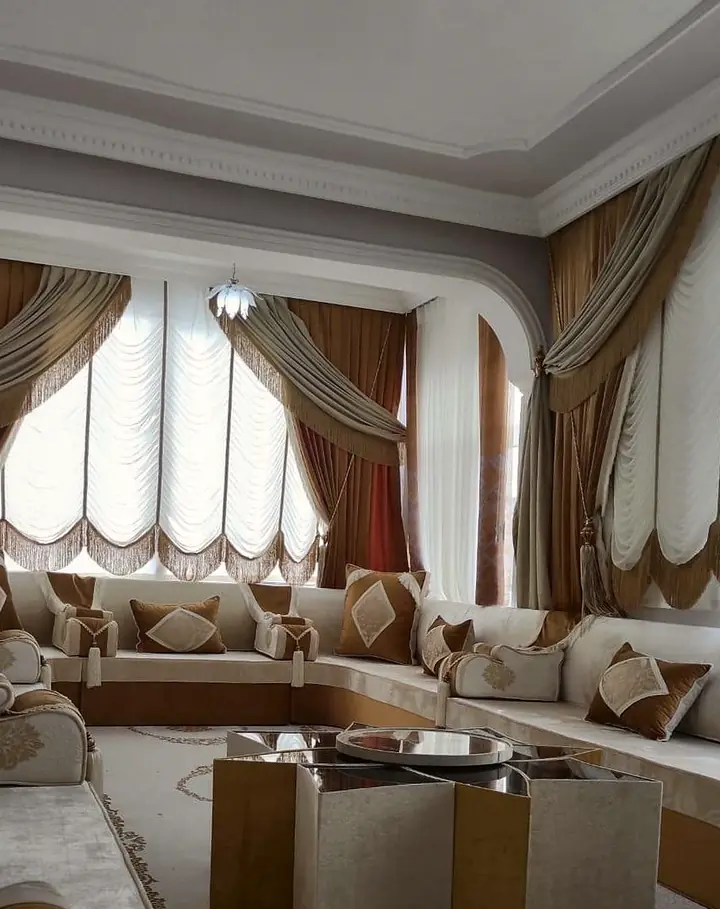
List the height of each run on the room drawing when you request a mixed layout. The designer can then confirm how the pieces meet and which builds are being used, instead of assuming that all photographed seats share one profile.
Can I order an in-between thickness, such as 6 in (15 cm) or 10 in (25 cm)?
Seats come in four fixed steps, 4 in (10 cm), 8 in (20 cm), 12 in (30 cm) and 16 in (40 cm), because sets are built and sewn around them. When the height you want falls between two steps, the designer quotes both neighbors side by side, so you can weigh comfort against cost.