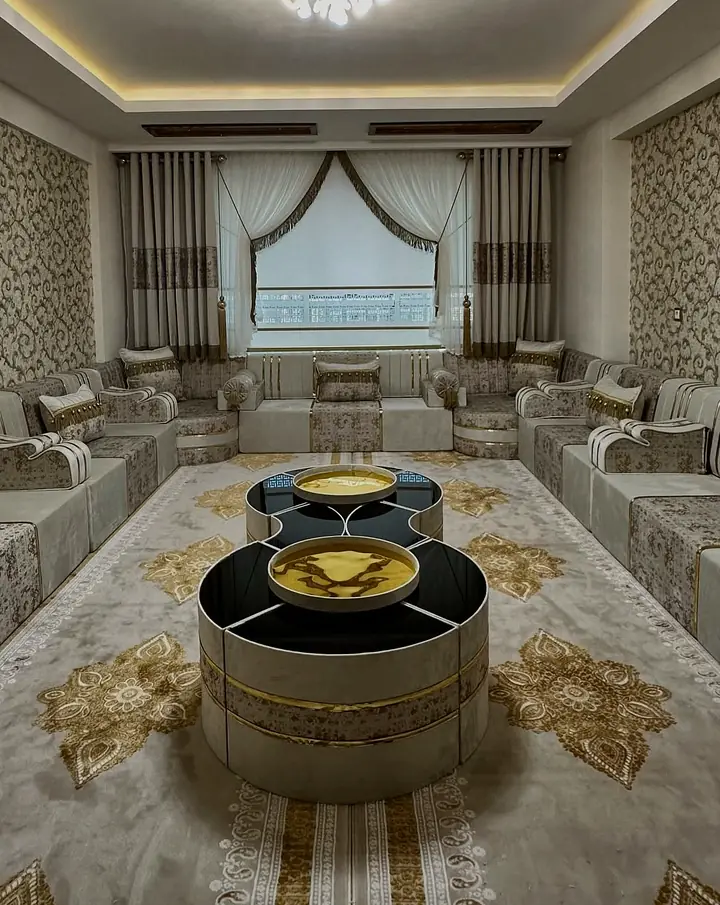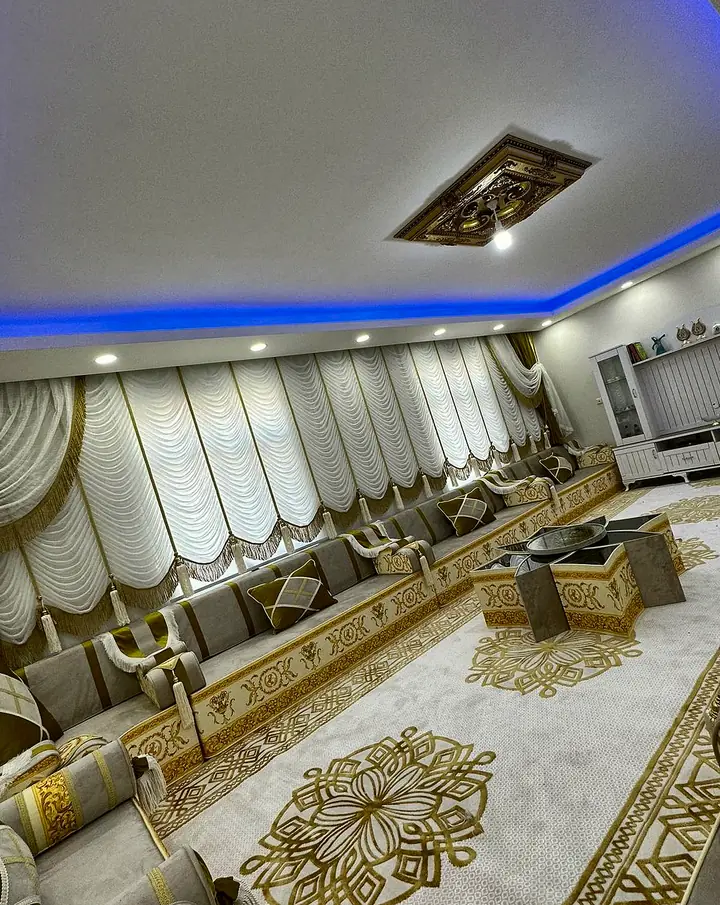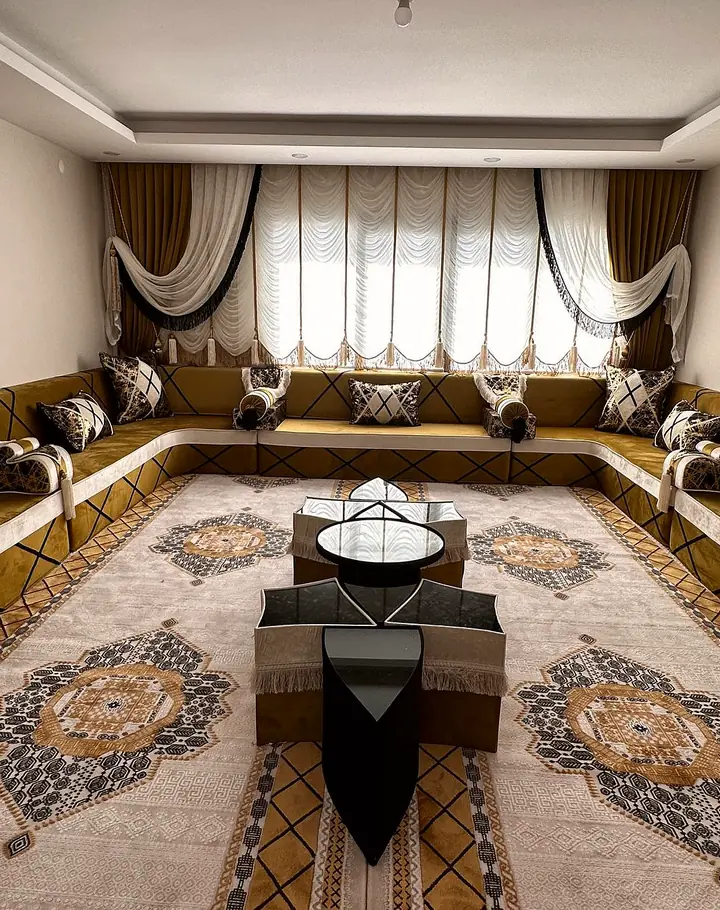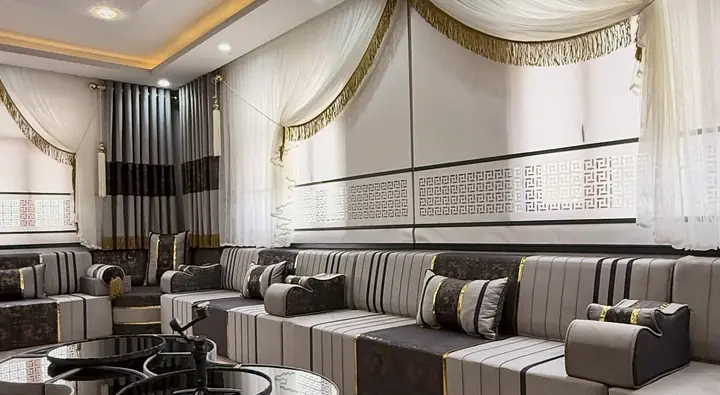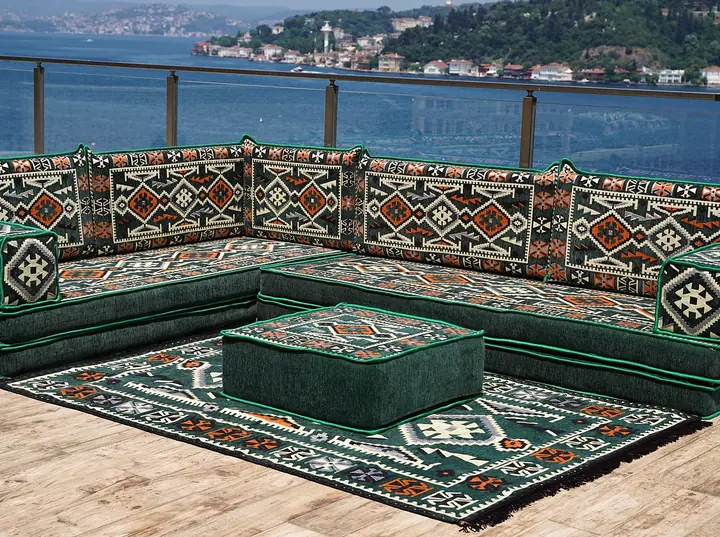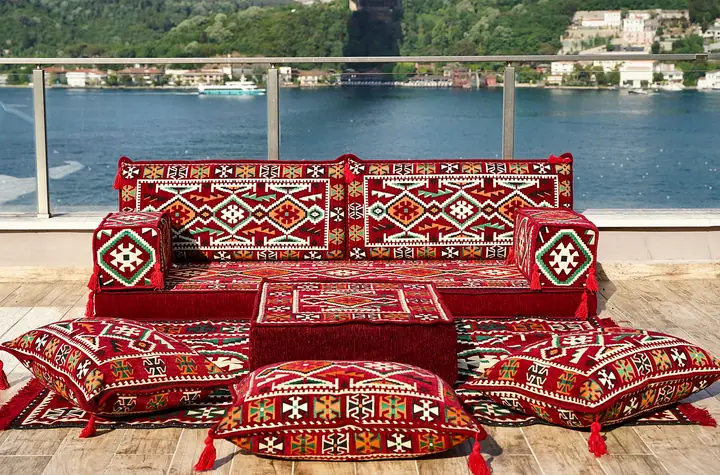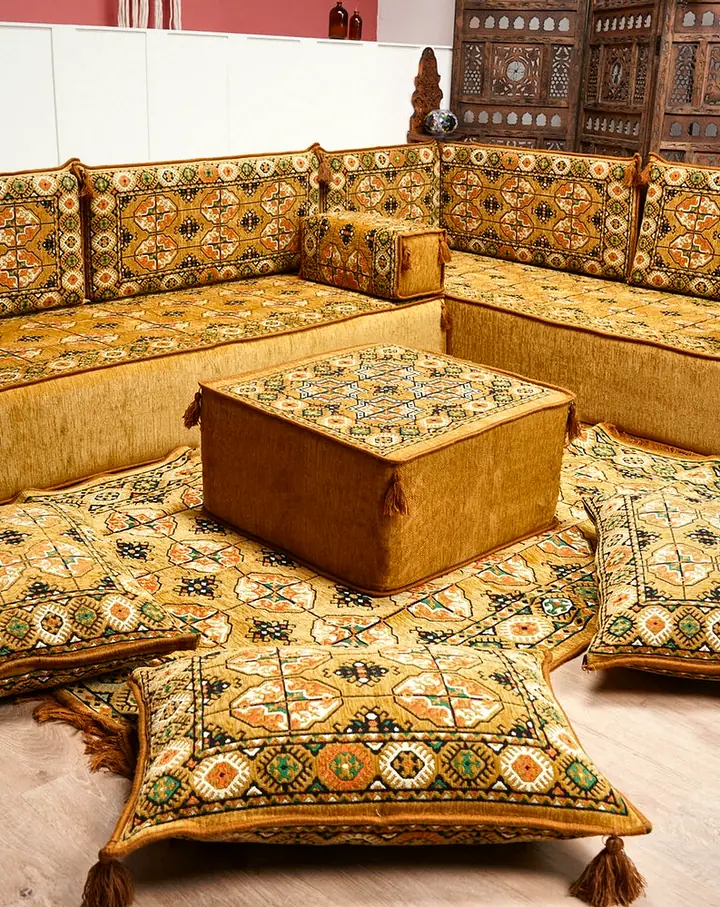
Afghan sofa set or Afghan majlis sofa: how does a toshak differ from a majlis?
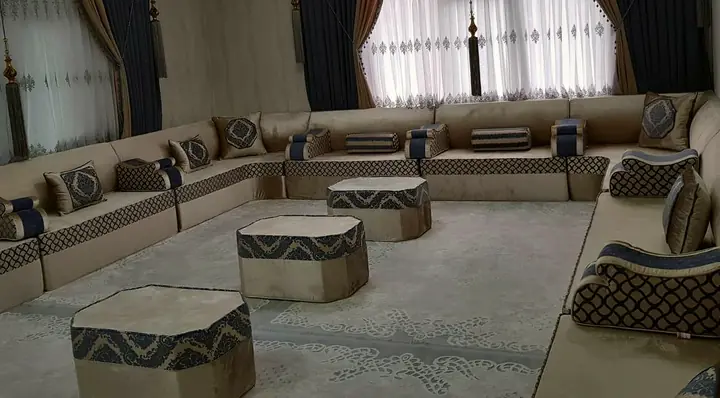
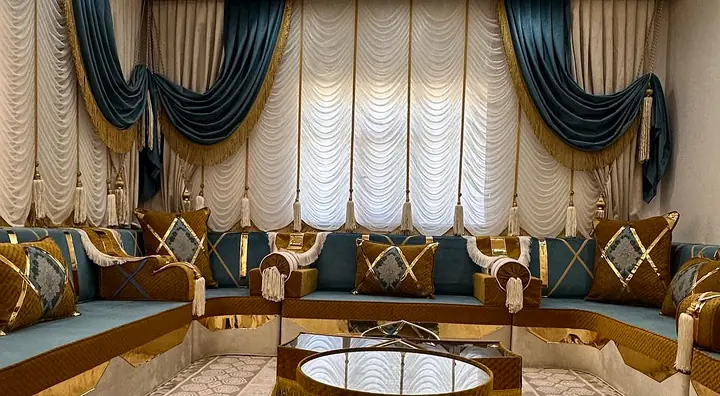
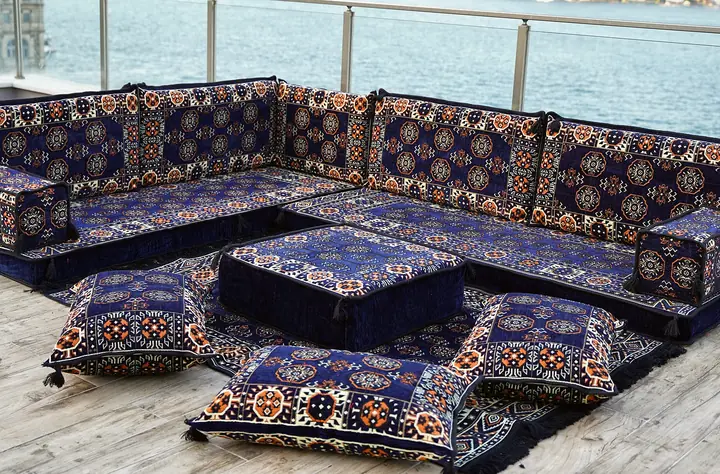
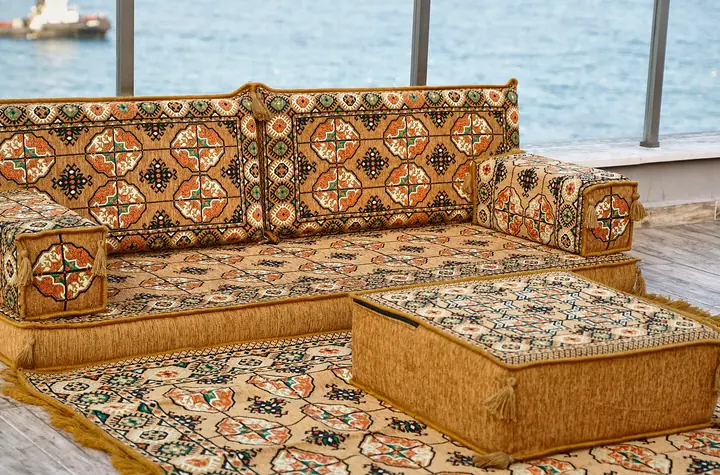
A toshak is a firm floor mattress laid along the wall with long back cushions, the balesht, against it, and an Afghan sofa set or Afghan majlis sofa is that arrangement cut to a room. An Arabic majlis adds fitted backrests and armrests and can stay on the floor or rise to sofa height. Patterns are shown with our toshak cushions and balesht backrests.
| Build | What it is | Seat height | Suits |
|---|---|---|---|
| Afghan toshak | Floor mattresses with long back cushions | 4 in (10 cm) or 8 in (20 cm) | A guest room seated wall to wall |
| All-foam majlis | Seats, backrests and armrests in foam, no frame | 12 in (30 cm) or about 16 in (40 cm) | A living room used like a sofa |
| Wood-back majlis | Foam seat with a wooden or MDF backrest | 8 in (20 cm) or 12 in (30 cm) | Long runs that need a straight line |
| Wooden-base majlis | Wooden base and back with foam seats | 14.5 in (37 cm) to 16 in (40 cm), by model | Large rooms and runs with no wall behind |
From the atelier
Questions buyers ask
- Can a majlis be delivered to Minnesota, and where is it actually made?
- Every piece is cut and sewn for your room in our Istanbul atelier; there is no showroom or local stock in Minnesota. Rugs, curtains and tables ordered with the seating travel on the same order. Production time depends on your layout and the season — ask us for the current schedule.
- We live in a town home with no basement. Where does a majlis go?
- A majlis does not need a basement. In a town home it usually goes in the main living room or a spare room, along one or two walls, and an L leaves space for stairs and walkways. A 12 in (30 cm) seat or a lower one keeps it in proportion with a smaller room.
Which build suits a large Minnesota room: wood back or all foam?
A room of about 180 × 168 in (457 × 427 cm) can take seating on three or four walls, and a wooden back keeps those long runs straight. Long Minnesota winter evenings are spent on these seats, so I would settle the height before the pattern; our notes on seat heights and import steps for US orders set the builds side by side.
Town home, apartment or basement: where does the seating go?
About 62% of new single-family homes started in the West North Central states have a basement, so a newer Minnesota house often seats its family room downstairs, while town homes and Twin Cities apartments seat one or two living-room walls.
- In a basement, measure from the foot of the stairs so the landing stays clear.
- On a TV wall, decide whether the run stops short or skips it, and note that length.
- Mark floor vents and outlets; cut-outs for them can go into the base.
- Send one wide photo of all walls and corners, plus a sketch with every length.
For tricky corners, use our printable worksheet for measuring a majlis room.
How are rugs, curtains and tables planned with the seating?
Seating takes about 27.5 in (70 cm) to 29.5 in (75 cm) of floor from each wall, so the rug is sized from the open middle of the room.
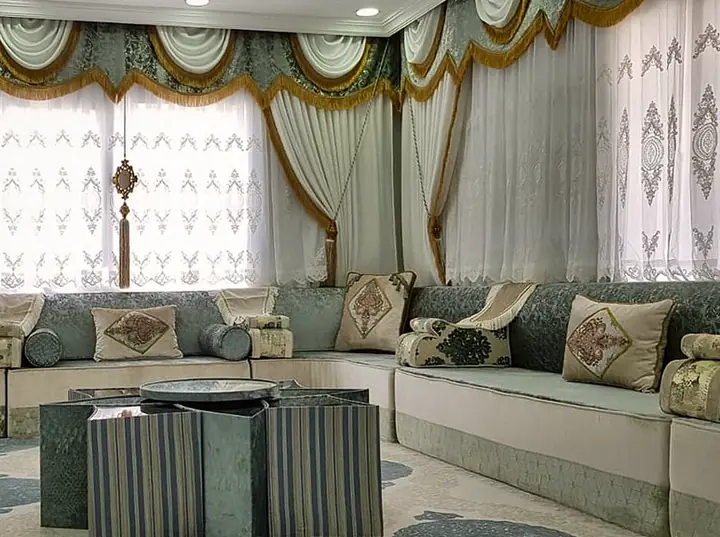
The kilim in a full set is flat-woven, not deep pile; if you add a pile rug, request a close-up video of that rug first. Curtains are cut for each window, and the matching tables can be star-shaped, round or square.
What happens when a Minnesota order arrives?
An order travels as several boxes, tracked one by one, and they may not all arrive on the same day.
Delivery to the US and Canada is by tracked express courier — ask us for the current transit estimate.
For US deliveries we prepay import duties and the courier's customs fees, so there's nothing to pay at your door. If a courier ever asks you for a duty or fee on this order, send us the notice and we'll settle it.
Each custom piece carries a number from the workshop, and the placement plan shows which seat, backrest and armrest goes on which wall. Lay everything out in plan order before pushing it into place, and let vacuum-packed foam rest for about a day before anyone sits on it.
| Minnesota time | Istanbul is ahead by | Noon in St. Paul is, in Istanbul |
|---|---|---|
| Central, summer | 8 hours | 8 p.m. |
| Central, winter | 9 hours | 9 p.m. |
Can the colors change later with new zippered covers?
The same design can be made in another color, so a black-and-gold model can be cut in navy and gold with its height and trim unchanged. New covers alone, without foam, can follow later, pillows first; ask the team for sizes. Covers unzip and can be machine-washed on a gentle 86°F (30°C) cycle.
Which Yemeni, velvet, linen and wooden-frame styles suit Minnesota homes?
Yemeni-style majlis designs keep a low line and patterned backrests, velvet and linen-look sets are separate collections, and sedir benches, often called cedar, are built on solid pine under a kilim-style weave. Single, L and U floor sofas and diwan sets suit a first apartment, and a full set adds a rug, an ottoman table and three pouf pillows.
Where do Minnesota's Arab and Somali communities live?
Most of the state's Arab and Somali families live around Minneapolis and Saint Paul, with Somali communities in Rochester and St. Cloud too.
| Place | What the figures show | Source |
|---|---|---|
| Minnesota | About 26,400 residents of Arab ancestry, about 0.5% | ACS 5-year |
| Minnesota | About 63,000 of Somali ancestry, the largest Somali community in the US | ACS 5-year |
| Minneapolis-St. Paul metro | About 51,300 of Somali and 20,500 of Arab ancestry | ACS 5-year |
| Hennepin County | About 26,700 of Somali ancestry | ACS 5-year |
| Minnesota | Lebanese about 7,600, Egyptian about 4,300; Afghan about 1,000, counted separately | ACS 5-year |
| Minnesota | An inclusive estimate of about 161,900, counting Somali and Sudanese residents | AAI fact sheet |
Families across the borders plan the same way, whether for an Arabic majlis in Wisconsin or Arabic sofas in Iowa.
What do Minnesota winters change about floor seating?
January in Minneapolis brings daytime highs near 23°F (-5°C), nights near 9°F (-13°C) and, over the year, around 51 in (130 cm) of snow, so only about five months, May to September, suit a patio. Ramadan evenings and Eid mornings happen indoors, and a kilim under the seats softens a cold floor.
Can Minnesota retailers and furniture stores order majlis sets?
Furniture businesses can order standard sets for stock or display, and custom sizes for their own customers, with terms set by models, quantities and fabrics. One Minnesota retailer planning a store of about 4004 sq ft (372 m²) began with a list of models and quantities, the quickest route to trade terms. Ask us about freight options for large and commercial orders.
Local questions
Can we see the majlis on a video call before ordering?
Ask us for a design consultation — we can talk through your room on a video call. On the call you see fabrics and finished pieces and talk through your sketch, so keep the wall lengths and a few room photos at hand.
What seat height and depth suit a living room used like a sofa?
A raised seat of 14.5 in (37 cm) to 16 in (40 cm), depending on the model, sits close to an ordinary sofa, while lower seats keep the floor-level feel. A raised majlis is about 29.5 in (75 cm) deep, and the depth can be reduced for a narrow room.
How firm are toshak and majlis seats for everyday sitting?
The seat foam is firm to medium-firm, so cushions keep their shape under daily use, and a softer or firmer filling can be requested. Seats use high-density polyurethane foam — ask us for the exact density for your build.
Sources
- US Census Bureau, American Community Survey 5-year estimates, table B04006 (ancestry)
- US Census Bureau, American Community Survey 5-year estimates, tables B25003 and B25024 (housing)
- Arab American Institute, Minnesota demographics fact sheet
- US Census Bureau, Characteristics of New Housing (foundation type)
- Minneapolis climate normals, 1991 to 2020