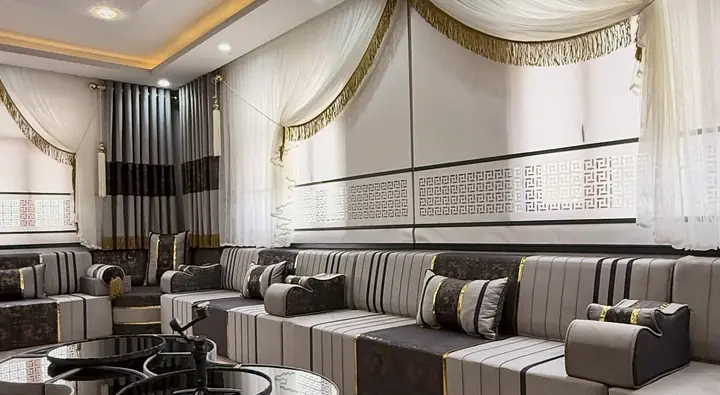
Diwaniya or majlis: what does the Kuwaiti word add?
Majlis (a sitting place) is the wider Arabic word. UNESCO's 2015 listing for the UAE, Saudi Arabia, Oman and Qatar describes majlis as rooms where people gather to exchange news, receive guests and talk over local matters. The diwaniya (a room for receiving guests, and the visit that happens there) is the Kuwaiti form of that idea, a reception area where a host receives colleagues and friends on a regular footing. Reference works trace its name to the Persian divan, a formal council room. The wider family of rooms is covered in the majlis, its parts and its regional names.
From the atelier
Questions buyers ask
- How many guests fit along one wall of a diwaniya?
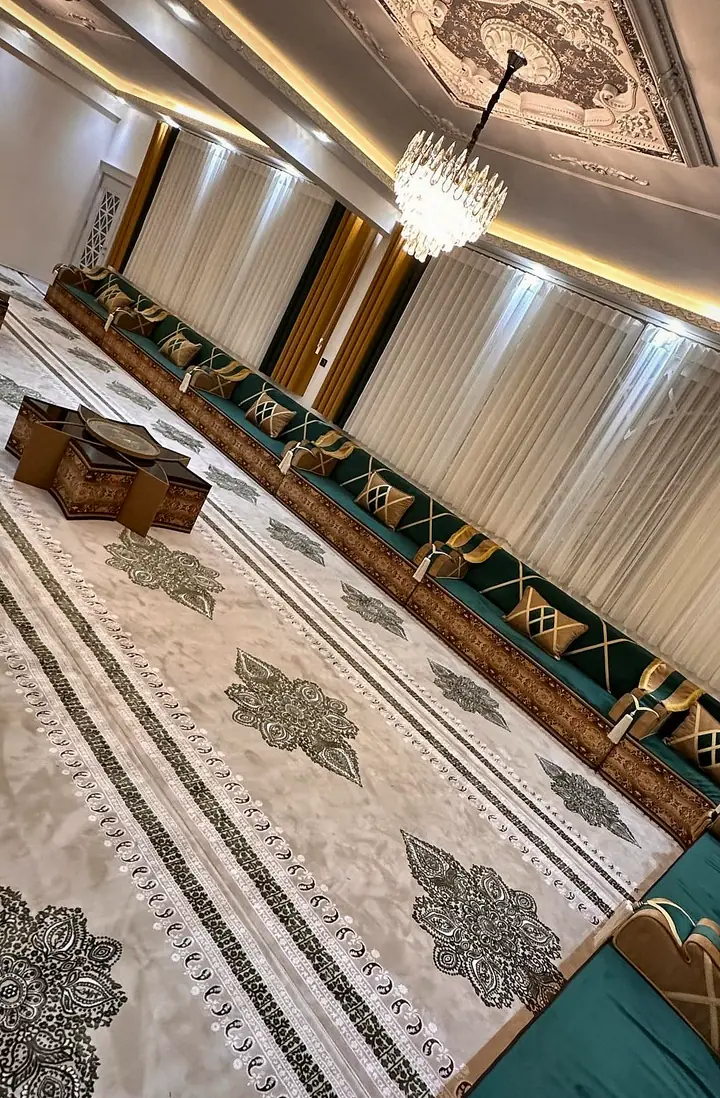
- Count seat cushions rather than floor area: each one holds two to three adults, so a wall carrying three cushions seats six to nine. The standard U-shaped set, about 224 in (570 cm) of seating in all, suits eight or nine adults, and a longer hall simply takes more cushions.
- Which seat height suits a diwaniya where older relatives come often?
- If getting up from a low seat is hard for anyone in the family, choose 12 in (30 cm), or 16 in (40 cm), where a raised majlis sits at about the height of a regular sofa. Guests who are happy sitting low can keep the classic floor-level room at 4 in (10 cm) to 8 in (20 cm).
Why do researchers treat the diwaniya as both a room and a practice?
A 2016 study in the Journal of Arabian Studies starts from a simple observation: Kuwaiti men attend diwaniya sessions so regularly that the habit is treated as a given of everyday life. The study argues that the word should cover both the literal room and the practice of gathering in it, because neither makes sense without the other. It also traces how the custom persisted through oil wealth, modernization and urbanization.
An earlier study in the same journal, from 2011, notes that men give these evenings so much time that some wives jokingly call the diwaniya the sharīka (a second wife). It is one of many guest-room customs gathered in the Atelier Journal's pages on culture and hospitality.
A 2016 study in the Journal of Arabian Studies treats the Kuwaiti diwaniya as both a room and a practice that outlasted oil wealth and urban growth.
What does a diwaniya evening look like from the door?
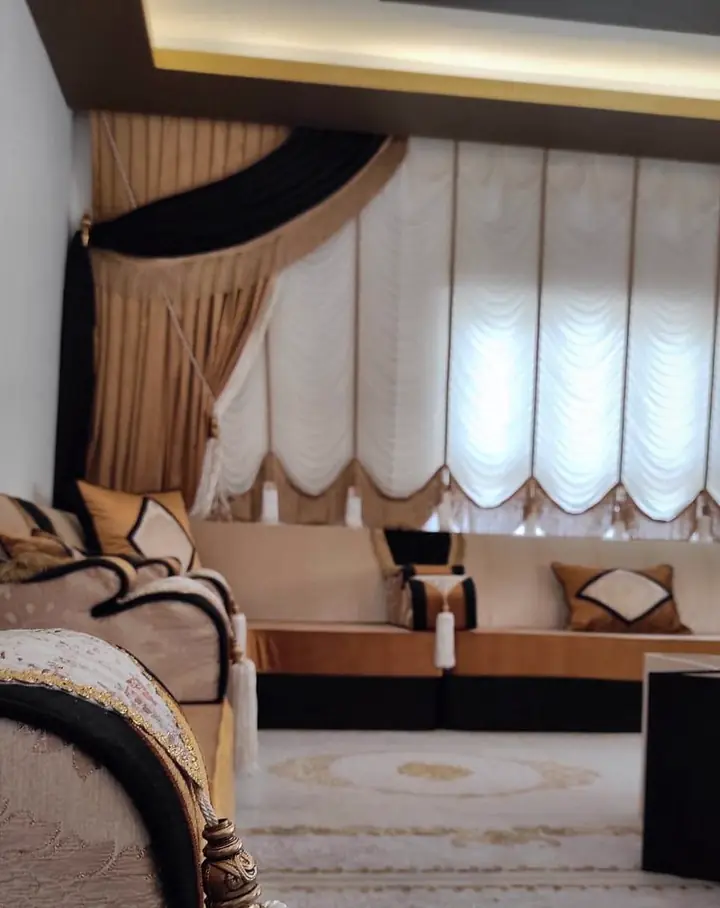
Guests step in, greet the room and take whatever seat is free along the walls, while the open floor in the middle is left for trays and for people crossing to greet one another. UNESCO's description of the majlis, written for neighboring states, fits a Kuwaiti diwaniya well: carpets on the floor, cushions against the wall and a place to prepare coffee close at hand. The talk wanders from family news to work to whatever the week has brought, and a newcomer learns the rhythm by sitting through a few evenings. I like how quickly a second visit stops feeling like a visit at all.
Which textiles dress a diwaniya, from Al Sadu bands to velvet?
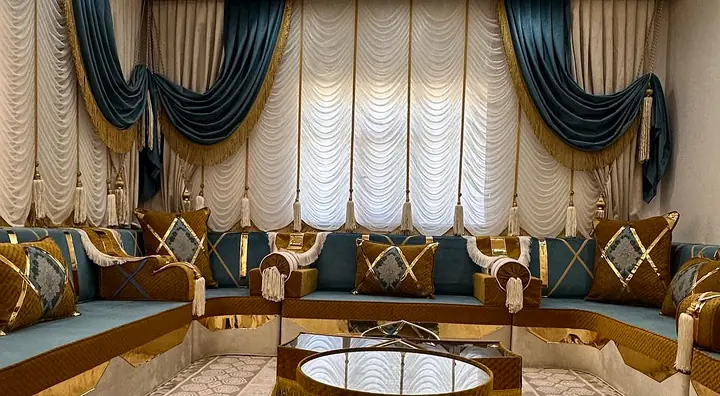
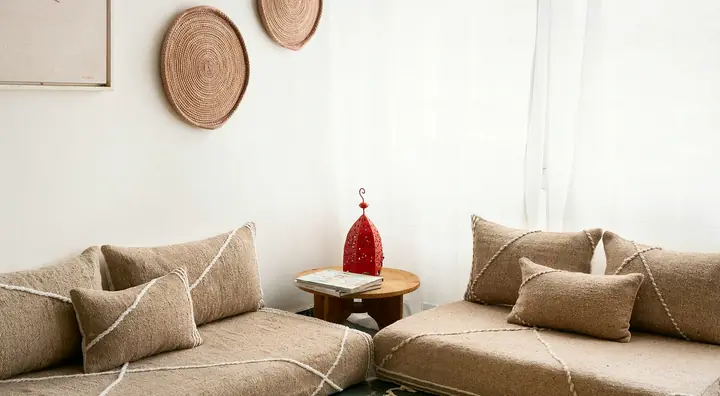
Al Sadu, the Bedouin weaving that UNESCO inscribed in 2020 for Kuwait and Saudi Arabia, is the textile many Kuwaiti families connect with the guest room. UNESCO describes Bedouin women weaving it on a ground loom, using natural fibers and geometric patterns repeated in a steady rhythm, often in reds and oranges, for tents, cushions and rugs. Sadu-style bands are a familiar sight on cushions and runners beside seating covered in velvet or chenille. For a new room, our atelier offers Turkish velvet, chenille, linen-look weaves and cotton-polyester blends.
How did women make the diwaniya their own as well?
For much of its history the diwaniya was a men's room, a place for business, friendship and long evenings out of the house. The 2011 study in the Journal of Arabian Studies calls the institution malleable, flexible in its roles, its form and its membership. That flexibility, it argues, let the diwaniya become a gateway for Kuwaiti women and a forum for networks reaching beyond the family. In many homes, a women's diwaniya keeps the same shape: regular evenings, seats along the walls and a host who keeps the door open.
What happens to the diwaniya when a family moves abroad?
Outside Kuwait, few families have room for a separate hall, so the gathering moves into whatever space the house allows, often a finished basement or a large front room in North America or Britain. What travels is the appointment itself: a regular evening, familiar faces and coffee ready before anyone rings the bell. The furniture shrinks to fit the house, and the visit keeps its old pace. Hospitality is a habit before it is a room.
How many seats does a diwaniya need, wall by wall?
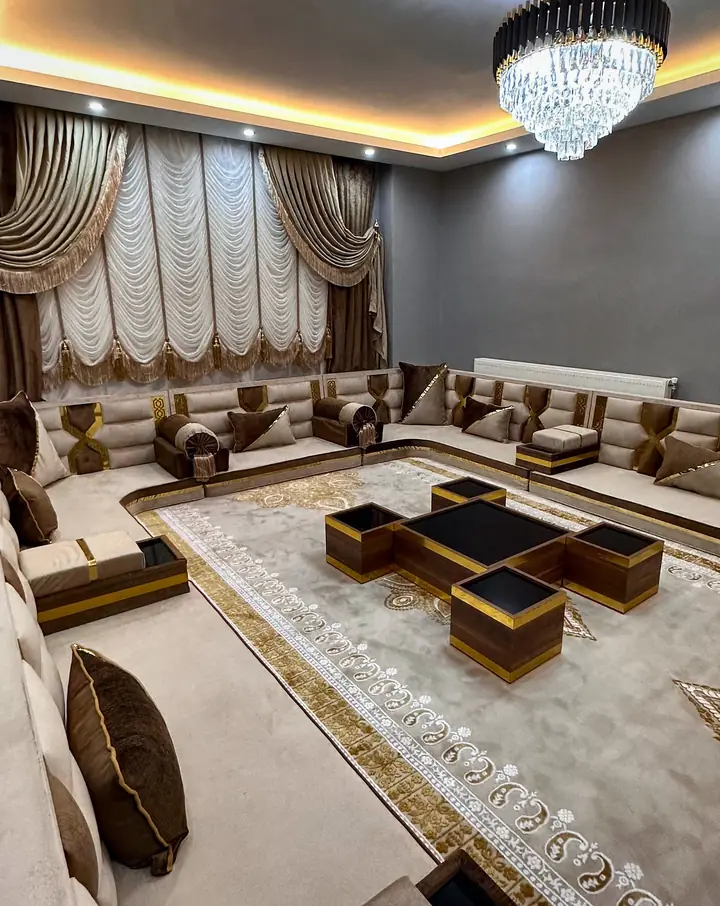
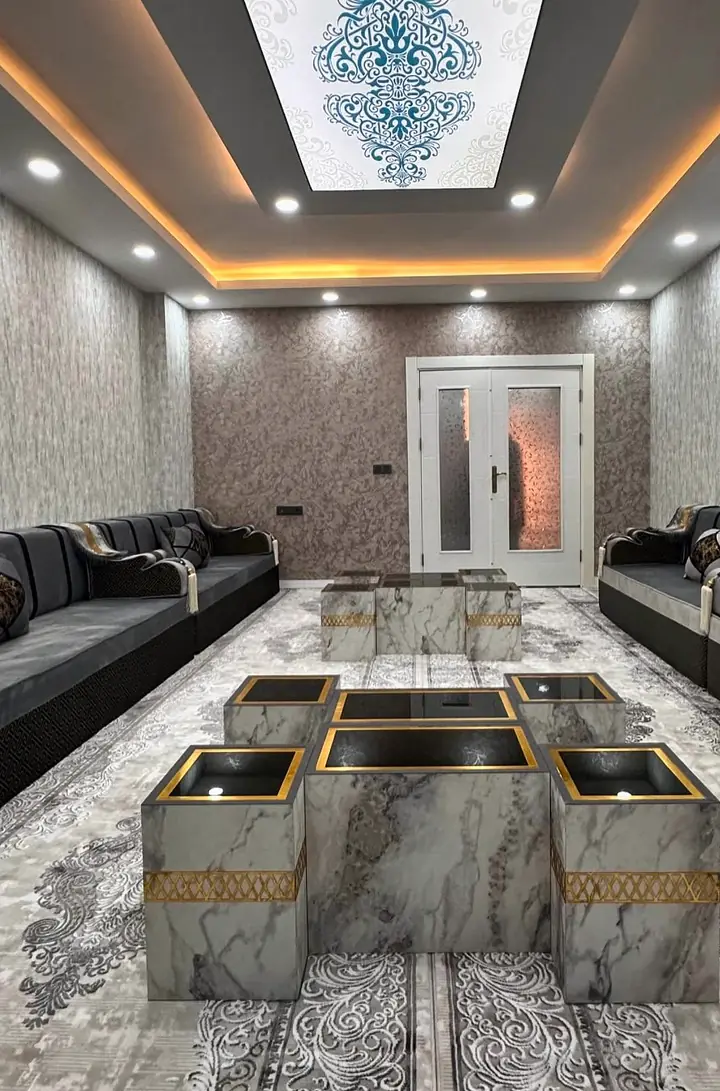
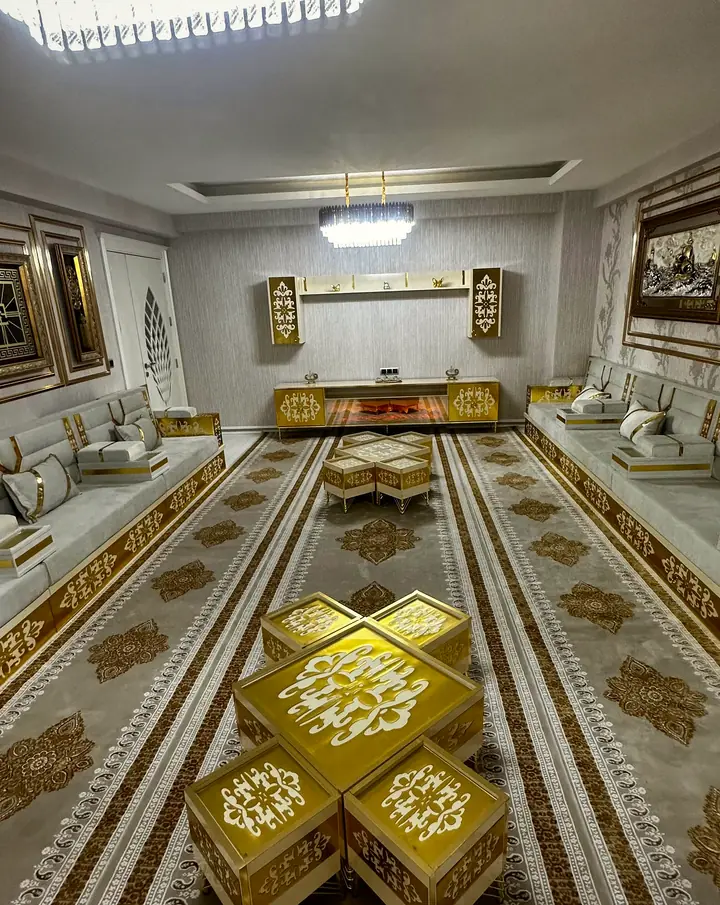
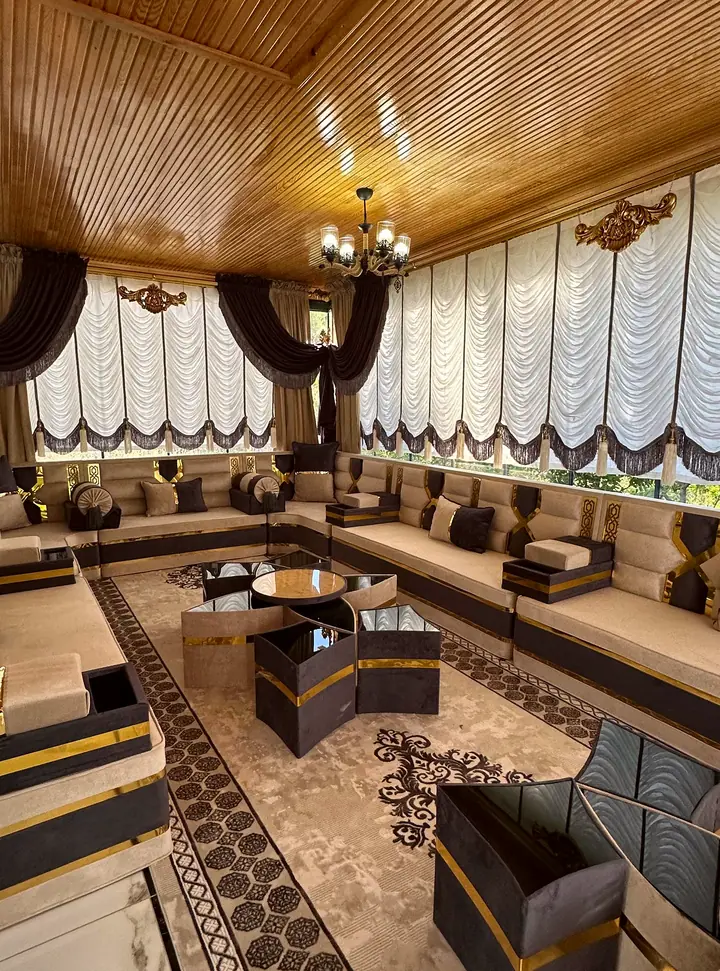
Seating for a diwaniya is worked out one wall at a time, because the pieces are cut to the walls. No single seat piece runs past 75 in (190 cm), so a 213 in (540 cm) wall is divided into three equal seats of 71 in (180 cm), each one seating two or three guests. On the second wall of an L or U, the seating stops one seat depth, about 27.5 in (70 cm), short of the corner, because the corner already belongs to the first wall's run.
- Depth: allow about 29.5 in (75 cm) out from each wall for a custom or raised majlis, and about 27.5 in (70 cm) for floor sofa sets.
- Backrests: two per seat, each 16 in (40 cm) tall, so a three-seat wall carries six.
- Rug: the matching rug is flat-woven in a kilim style rather than a deep-pile carpet.
- Tables: one large table ringed by four smaller ones, or a nesting set in 5, 7 or 9 pieces that grows with the guest list.
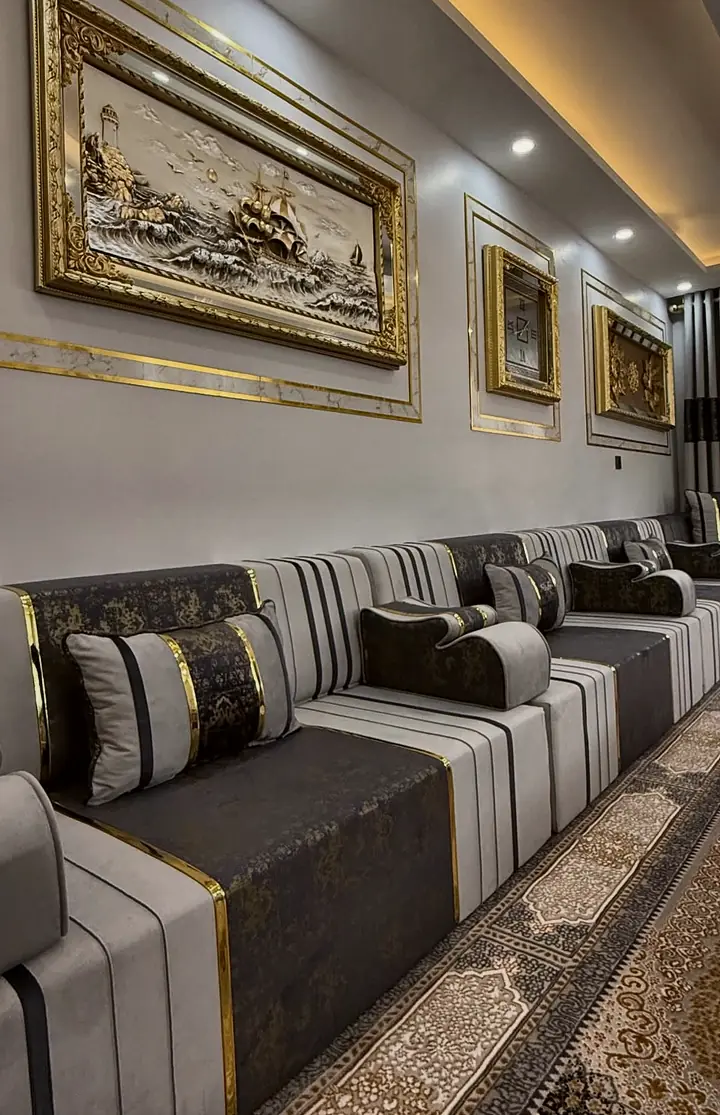
When the wall lengths are ready, Arabic majlis sets cut to each wall are planned from them piece by piece. For where runs stop at doors and windows, see layouts for a single wall, an L or a U.
Late in the evening, when the last tray goes back to the kitchen, the cushions still hold the shape of the people who sat there.
Frequently asked questions
How do you spell diwaniya in English?
There is no single spelling. Diwaniya and dewaniya are common in everyday English, diwaniyah also appears, and scholarly writing such as the Journal of Arabian Studies uses dīwāniyya. All of them name the same room and the same gathering.
Is a diwaniya only for men?
Traditionally it has been a men's gathering. The 2011 study in the Journal of Arabian Studies shows how Kuwaiti women have also taken up the diwaniya as a forum of their own, using it to widen their circles beyond family ties.
Did the diwaniya change after oil wealth reached Kuwait?
It changed its setting more than its purpose. The 2016 study in the Journal of Arabian Studies traces how the room and the regular visits persisted through oil wealth, modernization and urbanization, keeping their place in daily life.