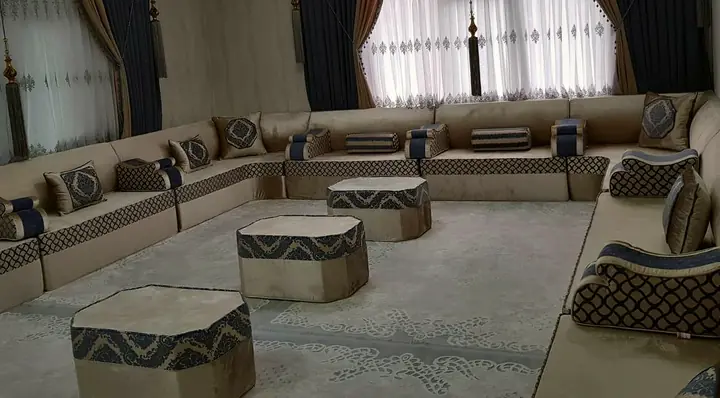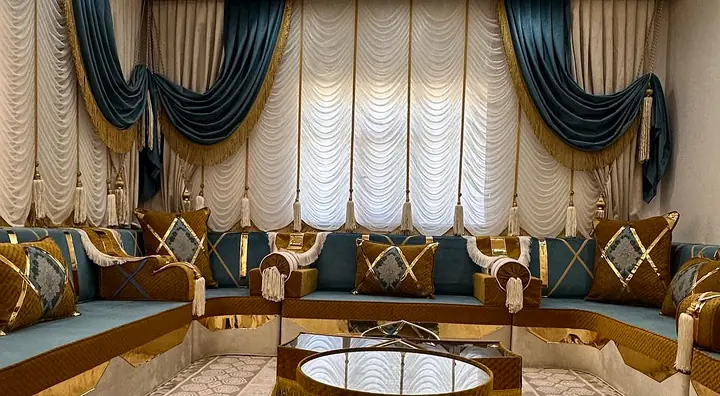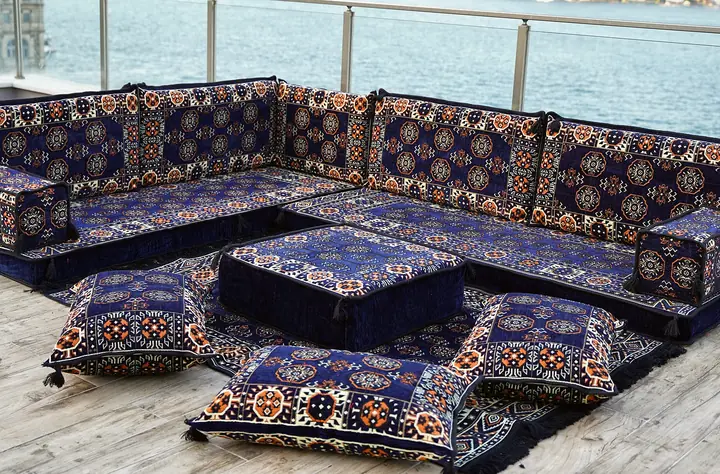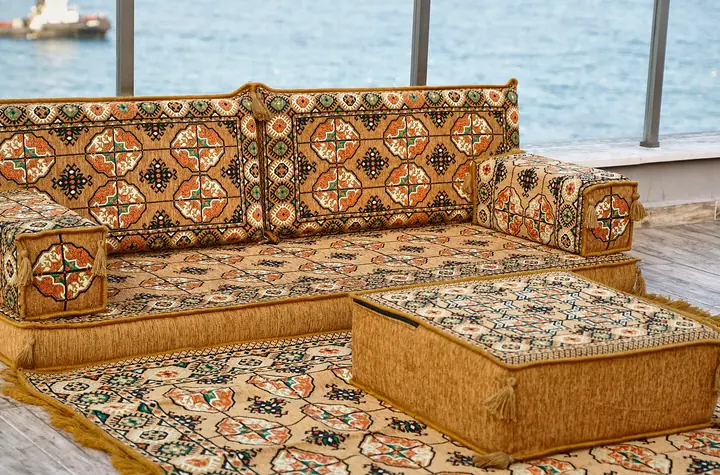
What does a rug have to fill in a majlis room?
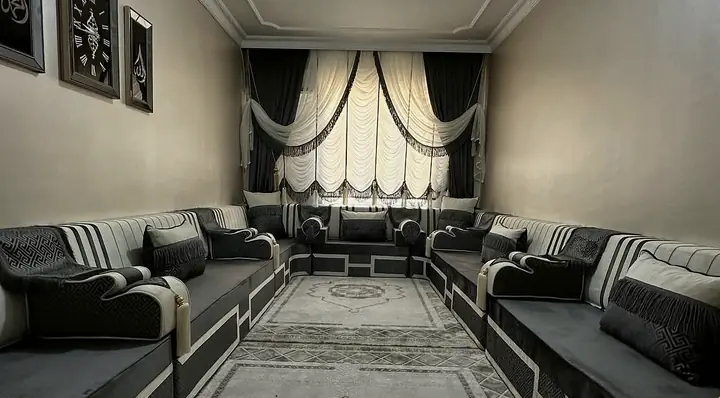
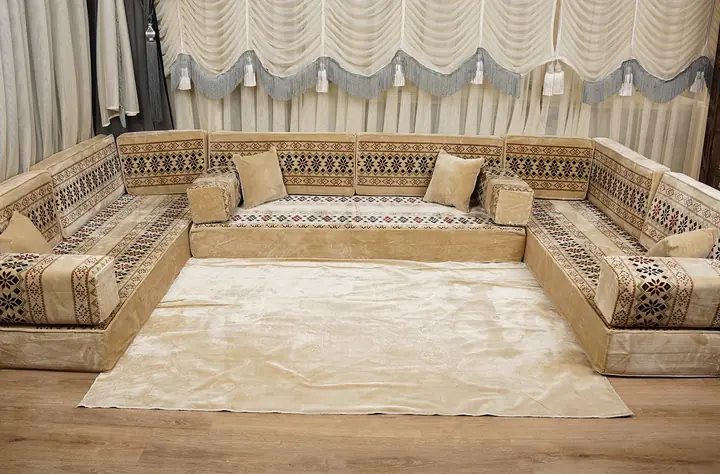
In a majlis photo the eye lands on the rug before the cushions, because it is the one surface every seat faces. A sofa on legs often tucks a rug under its front feet. Floor seating has no feet, so the rug either fills the open floor inside the seat fronts or runs under the whole room. Its size is the last figure in a plan that begins at the walls, where the room-planning guides for floor seating start.
From the atelier
Questions buyers ask
- How big is the rug that comes with a set, and can I get one for the whole room?
- Ask us whether a matching rug is included with your set. A set rug lies in front of the seats rather than filling the room, and velvet and linen full sets have none. For more floor, stock rugs reach 79 × 118 in (200 × 300 cm), or a made-to-size rug can cover the room.
- My rug is already down. Should the majlis match its size or run bigger?
- The seating can match the rug or run larger, as long as the strip of floor between rug and seats is even on every side. One run pressed against the rug while the opposite one stands far off looks wrong. Send the rug size with your wall lengths, and the design team draws an L or U that frames it.
How do you work out a rug size from your seating plan?
- Mark which walls carry seating and which side of the room stays open.
- Note the seat depth, about 27.5 in (70 cm) on a floor sofa set and about 29.5 in (75 cm) on a custom or raised majlis.
- Subtract that depth from the room's length once for each seated wall at either end.
- Subtract it from the room's width in the same way.
- Take off the strip of bare floor you want between the rug and each seat front.
- On the open side, stop the rug before the walking path to the door.
- Round down to the largest stock size that fits, or ask for a rug made to the exact figure.
I treat the result as a frame rather than a target. A medallion rug needs its center in the middle of the open floor, while an all-over kilim repeat can run closer to the seats. Big medallions want long walls, and small repeats forgive short ones.
How much open floor do standard floor sofa sets leave for a rug?
I read a set the way I read a border, from its inside edge, because the seat fronts are the frame the rug sits in.
| Set | Seating footprint | Open floor inside the seat fronts | Stock rug that fits |
|---|---|---|---|
| Single, one 75 × 27.5 in (190 × 70 cm) seat | 27.5 in (70 cm) out from one wall | 75 in (190 cm) wide, as deep as the room allows | 47 × 71 in (120 × 180 cm) along the seat |
| Standard L, two seats | About 75 × 102 in (190 × 260 cm) | About 47 in (120 cm) by 75 in (190 cm) in the inside corner | 47 × 71 in (120 × 180 cm), touching both seat fronts |
| Standard U, three seats | About 75 in (190 cm), 130 in (330 cm) and 75 in (190 cm) along the walls | About 75 in (190 cm) by 47 in (120 cm), plus the floor past the open end | 47 × 71 in (120 × 180 cm) inside, or 67 × 94 in (170 × 240 cm) running past the open end |
Which rug fits inside a custom U along three walls?
Take a 197 in (500 cm) by 157 in (400 cm) room with a custom majlis along the back wall and 118 in (300 cm) down each side, so the last 39 in (100 cm) by the door stays clear. With seats 29.5 in (75 cm) deep, the side runs stand 138 in (350 cm) apart, and the back seat fronts sit 89 in (225 cm) from the open end of the U.
Rounding down gives the largest stock rug, 79 × 118 in (200 × 300 cm), laid with its long side across the room. An even strip of 10 in (25 cm) then stays bare on all three seated sides, and the rug's open edge lines up with the ends of the side runs. A rug made to size could fill the whole 138 × 89 in (350 × 225 cm) frame instead.
Flat-woven kilim or pile carpet: which suits floor seating better?
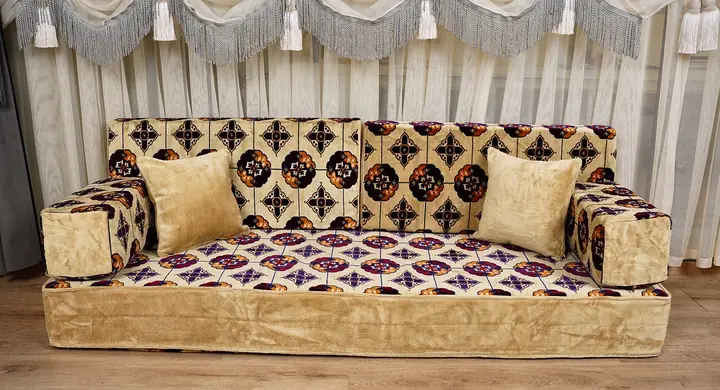
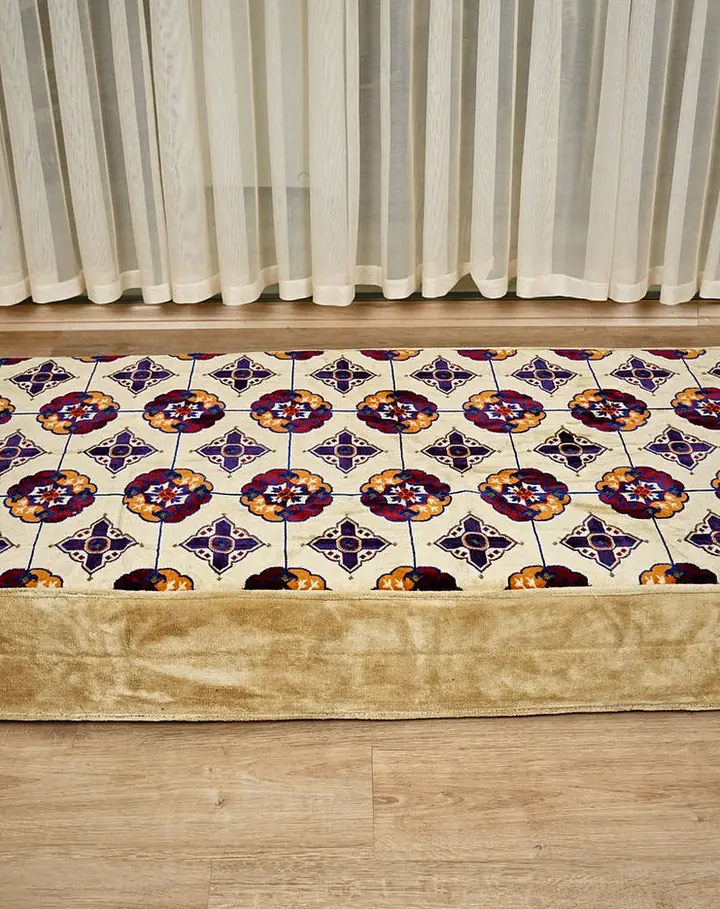
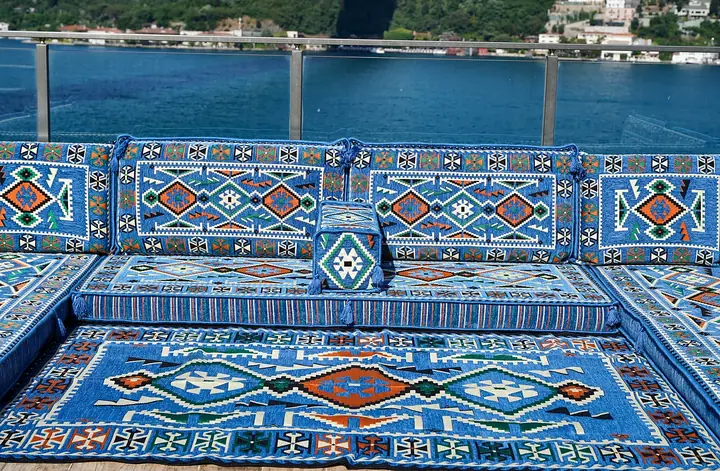
A flat-woven kilim has no pile, so its motifs sit on the surface with crisp, stepped edges, just as they left the loom. An Arabic majlis carpet with a raised pile softens the same motif and adds height underfoot. The matching rug of the kilim-pattern floor sofa sets is the flat-woven kind.
| Point | Flat-woven kilim | Pile carpet |
|---|---|---|
| Surface | No pile, motifs flat with sharp edges | Raised pile, motifs read softer |
| At the seat fronts | Thin, so cushions beside it stay level | Thicker, so a seat resting half on its edge can tilt |
| From a low seat | Borders stay clear at close range | Color reads deeper, detail softer |
Which rooms break the simple rule, from four seated walls to a long hall?
| Situation | What happens to the open floor | What to do with the rug |
|---|---|---|
| Seating on all four walls | Twice the seat depth comes off each way, and the door needs a path | Center one rug and keep the path to the door bare |
| Long hall | It runs longer than 118 in (300 cm), the longest side of any stock rug | Lay two or three same-size rugs in a row, or ask for one made to size |
| Seats made shallower for a narrow room | Each seated side gives back floor at 19.5 in (50 cm) to 23.5 in (60 cm) deep | Size the rug after the depth is settled |
| Velvet or linen full set | The set brings an ottoman and pouf pillows but no rug | Order a rug on its own, sized from the open floor |
What makes a majlis rug look too small or too big?
- Sizing the rug from the walls, so its edges vanish under the seats.
- Leaving a wide strip on one side and none on the other, so the rug looks pushed toward one run.
- Placing one small rug in a long hall where two in a row would fill the floor.
- Choosing a design in a size it is not woven in, since not every stock size comes in every design.
- Letting a seat rest half on and half off the edge of a thick pile carpet.
- Ordering the rug before a custom seat depth is settled, so the open floor changes afterward.
Which rug choices go on your order next to the seating?
| Choice | Options |
|---|---|
| Where it lies | Inside the seat fronts, or under the whole room |
| Size | Stock from 31.5 × 79 in (80 × 200 cm) to 79 × 118 in (200 × 300 cm), or made to size |
| Number | One rug, or matching rugs in a row |
| Weave | Flat-woven kilim style, or a pile carpet you already own |
| How it is ordered | With the seating, or as a rug on its own |
Seat, rug and curtain pairings are set out in majlis color combinations, and the stock weaves sit together under kilim rugs. For an odd corner or a pillar, a video call with one of our designers settles the open floor with you.
Frequently asked questions
What if the floor inside my seating is bigger than any stock rug?
A large rug for a majlis room can be made to the floor's size, or stock rugs of up to 79 × 118 in (200 × 300 cm) can be laid edge to edge. Measure across the seating, seat front to seat front, in both directions, and the designers suggest one rug or a combination.
Should an Arabic majlis rug run under the floor cushions or stop at the seat fronts?
A center rug stops at the seat fronts and leaves the cushions on bare floor, while a rug made to the room's size runs under the seating as well. Both look settled. What to avoid is an edge ending halfway under a seat, where the cushion sits unevenly.
Can two stock rugs side by side replace one large rug?
Two rugs of the same size and design, laid edge to edge, cover a long or wide floor well, and a big room can hold several. Check that your design is woven in that size, because not every stock size comes in every design.
Is it better to size the rug before the seating arrives or after?
Planning it with the seating puts the rug on the same order, worked out from the plan. Measuring once the seats are in place gives the exact open floor, which helps most when the seat depth was changed for your room.